


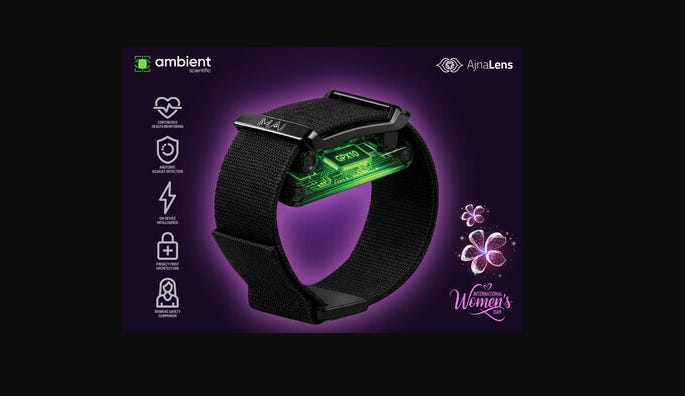
A new AI-powered wearable designed for women’s health and safety — capable of running continuously for up to two weeks without charging — has been unveiled as developers push to make always-on monitoring practical in regions with limited connectivity.
The device — called MAI — is the result of a collaboration between US-based semiconductor company Ambient Scientific and Indian deep-tech firm Dimension NXG. The wearable combines everyday health tracking with built-in safety features, while running artificial intelligence directly on the device rather than relying on cloud processing.
The companies say this approach allows MAI to function even in areas with weak network coverage, while also keeping sensitive biometric data private by default.
“MAI is built to be a health companion women can rely on in the real world, not just in ideal network conditions,” said Abhishek Tomar, chief technology officer at Dimension NXG AjnaLens.
“Ambient Scientific’s processor gave us the performance headroom to run intelligence locally on the wearable, with low latency and privacy by default, while still achieving up to 14 days of battery life.”
A wearable focused on safety and health
MAI is designed as a “women-first” health companion that tracks everyday vital signs such as heart rate and blood oxygen levels. Over time, the system builds a personalised baseline, allowing the wearable to flag meaningful changes rather than simply displaying raw numbers.
The device also includes a safety layer. It can detect falls, SOS gestures and opt-in stress signals, triggering alerts designed to act as a rapid response in potentially dangerous situations.
MAI is also intended to highlight patterns that may suggest emerging health concerns — including early risk signals associated with conditions such as polycystic ovary syndrome (PCOS) — potentially prompting users to seek medical advice sooner.
AI running directly on the device
At the core of the wearable is Ambient Scientific’s GPX-10 processor, a low-power chip designed to run artificial intelligence workloads directly on the device.
Many wearables rely heavily on smartphones or cloud services to process data. In contrast, MAI processes signals locally, meaning the device can continue working without constant connectivity and only shares data when users choose to.
“With the GPX-10, we have broken traditional power barriers, allowing Dimension NXG to run sophisticated, multimodal AI models locally and continuously,” said GP Singh, chief executive of Ambient Scientific.
The extended battery life is also intended to make the wearable more practical in parts of India where access to electricity or reliable connectivity may be inconsistent.
Field trials in India
The MAI wearable will begin its first large-scale field trials this month, with thousands of devices set to be distributed to pre-order customers and trial participants across India.
Dimension NXG plans to scale deployment to more than 10,000 units by the end of the year as the product moves toward additional medical-grade certifications.
The launch reflects a growing push within the wearable technology sector to develop devices tailored specifically to women’s health — an area long underserved by mainstream consumer technology - and also increasingly ensure greater accessibility too.