


A Nordic women’s health initiative launching today is making the case that coordination is key to progress in the sector.
The Nordic Women’s Health 2040 Implementation Playbook, developed with the Copenhagen Institute for Futures Studies, attempts to create a shared framework connecting women’s health research, care, policy and innovation across the Nordic region.
The Playbook builds on the Nordic Charter for Women’s Health 2040, first launched in late 2025 and published in The Lancet, which brought together more than 136 contributors from across Denmark, Finland, Iceland, Norway and Sweden - including researchers, clinicians, policymakers, founders and patient advocates - around the question: what would it look like to design women’s health at a systems level rather than through disconnected initiatives?
“We do not need one more strategy,” says Julia Persson, founding architect of the initiative. “We need to have an architecture.”
The architecture itself emerged from independent validation by five independent expert groups who all arrived at the same underlying structure when asked to design at the system level. It’s this that Julia treats as the signal that the framework reflects a system properly, rather than imposed design.
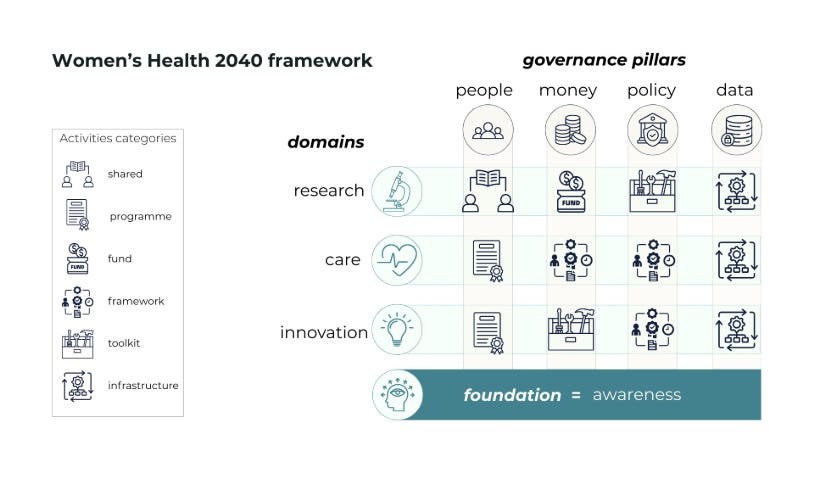
The framework is structured around three operational domains - research, care and innovation - intersecting with four enabling pillars: people, money, policy and data, and one ‘cognitive foundation’ – awareness. Within that frame, the Playbook names twenty-eight infrastructure needs, each anchored to a Nordic or European initiative already underway. The goal, according to Julia, is not to prescribe a single roadmap, but to help institutions and organisations identify how their existing work fits into a wider ecosystem.
“The Playbook is not asking organisations to join a programme,” Julia says. “It gives them a shared architecture they can use immediately within their existing mandate.”
“At the moment, a lot of activity is happening in parallel,” she says. “The purpose is to surface what people are already doing and help them work together.”
The AI and data urgency
A major focus of the Playbook is the question of what happens as healthcare systems become increasingly shaped by AI, data infrastructure and interoperability standards.
Julia explains that the current pace of technology and how that is shaping healthcare, drives an urgent need for the framework. Many of the frameworks now shaping future healthcare - from European health-data standards to AI systems - are being built on historical datasets that have long underrepresented women’s health.
The initiative repeatedly references the estimated 14-year lag between research publication and routine clinical adoption, for example, arguing that women’s health should be viewed as a systems challenge involving data quality, standards and how evidence moves into practice.
Julia believes that creates a relatively narrow window to address those gaps before they become more deeply embedded in future healthcare systems.
“We have lived for years with the gap between research and care,” she says. “If we do not correct this bias now when we are setting up the standards for European health data - before we build AI models - then we will amplify this bias for many generations going forward.”
A testbed in the Nordics
So why the Nordics? Aside from the region being Julia’s home, the Playbook argues that the Nordics offer unusually favourable conditions for testing a more coordinated approach.
Together, the five Nordic countries combine relatively small populations with high levels of digitalisation, extensive health registries, strong public institutions and comparatively high public trust.
“We already have many of the components,” Julia explains. “We have trusted institutions. We have strong healthcare systems. We have digital infrastructure.”
The initiative also arrives as policymakers across Europe continue discussions around the future direction of women’s health policy at EU level, including proposals for a European Women’s Health Strategy.
Julia believes the Nordic countries have an opportunity to contribute more collectively to those discussions rather than through separate national approaches.
“We are 27 million people,” she says. “We can come together and speak with one voice instead of trying to do each national thing.”
An open framework
The obvious question of course, is how a framework like this becomes operational in practice.
What’s interesting about the project is that it has been structured as an ‘open commons’ framework, rather than a new NGO or formal membership body. This is intentional and allows the framework to be adopted voluntarily by institutions, networks and individuals already working in the space. A network of ambassadors and partner organisations are already engaged in amplifying and embedding the work.
“No single institution controls research, care, innovation, regulation, employers and data simultaneously,” she says. “That is why coordination has to emerge across the ecosystem rather than through one central authority.”
“I want people to own it and use it,” she says. “I just want to facilitate it and make sure people are using it.”
The idea is that organisations do not formally “join” the framework, but instead use the parts relevant to their existing work and mandates.
That could mean researchers using the Playbook to support Nordic funding or policy proposals, employers integrating women’s health literacy into ESG reporting ahead of future regulation, or ecosystem organisations using the data, analysis and mapping within their own initiatives.
Julia argues that the framework is designed to work alongside forces already reshaping healthcare systems, rather than relying on the Playbook itself to create momentum.
She points to three dynamics already underway.
The first is regulatory pressure, including European initiatives such as the European Health Data Space (EHDS), the AI Act and the upcoming FP10 research framework, all of which are beginning to shape standards around healthcare data, interoperability and AI infrastructure.
The second is bottom-up adoption across the wider ecosystem - from patient organisations and regional health systems to employers, professional societies and media platforms already working within women’s health.
“The work fits their existing scope,” Julia says. “It fits their mission and mandate already.”
The third is what she describes as “political-moment activation” - moments where ministries, Nordic institutions and research funders move when broader coordination windows emerge.
Alongside the Playbook, the initiative has also launched a weekly Nordic Intelligence Brief intended to track and surface examples of organisations acting early, creating visibility around what the framework describes as “first movers” across the ecosystem.
Women’s health as infrastructure
The phase ‘women’s health as infrastructure’ is a popular one within the sector. Julia sees awareness too as infrastructure - although not in the typical sense of awareness-raising.
During our call for this feature, Julia spoke about the idea that progress in women’s health is shaped by how societies understand these issues in the first place - not just by healthcare systems and policy.
And so, she explains “I decided to think about it as ‘cognitive infrastructure’, because I think that’s what it is. That’s how we think as a society.”
This rethink of the term awareness in women’s health has implications for the role of media, advocacy groups and information platforms operating in the sector.
We spoke about how platforms such as FutureFemHealth may operate and function less like traditional trade media and more like coordination layers connecting researchers, founders, policymakers, clinicians and public conversation - something that aligns closely with how I’ve also come to understand the role we play in the ecosystem.
The Playbook also references the need for stronger evidence-sharing and trusted information systems, including around the moderation and suppression of medically accurate women’s health content online - an issue documented through CensHERship’s campaigning and research, which is cited within the framework itself.
That awareness layer will become more important as women’s health moves further into debates around AI governance, public health infrastructure and data standards - particularly if information visibility itself shapes which issues receive attention, funding and clinical prioritisation.
For Julia, the real test of the framework will not be whether the Playbook itself becomes influential, but whether it helps create visible movement across the wider ecosystem.
“The idea is to accumulate the signals and trace where things are moving forward and where things are still standing still,” she says.
“My success would be if we can actually see movement in women’s health - if we can see progress compared to the snapshot we have today.”