


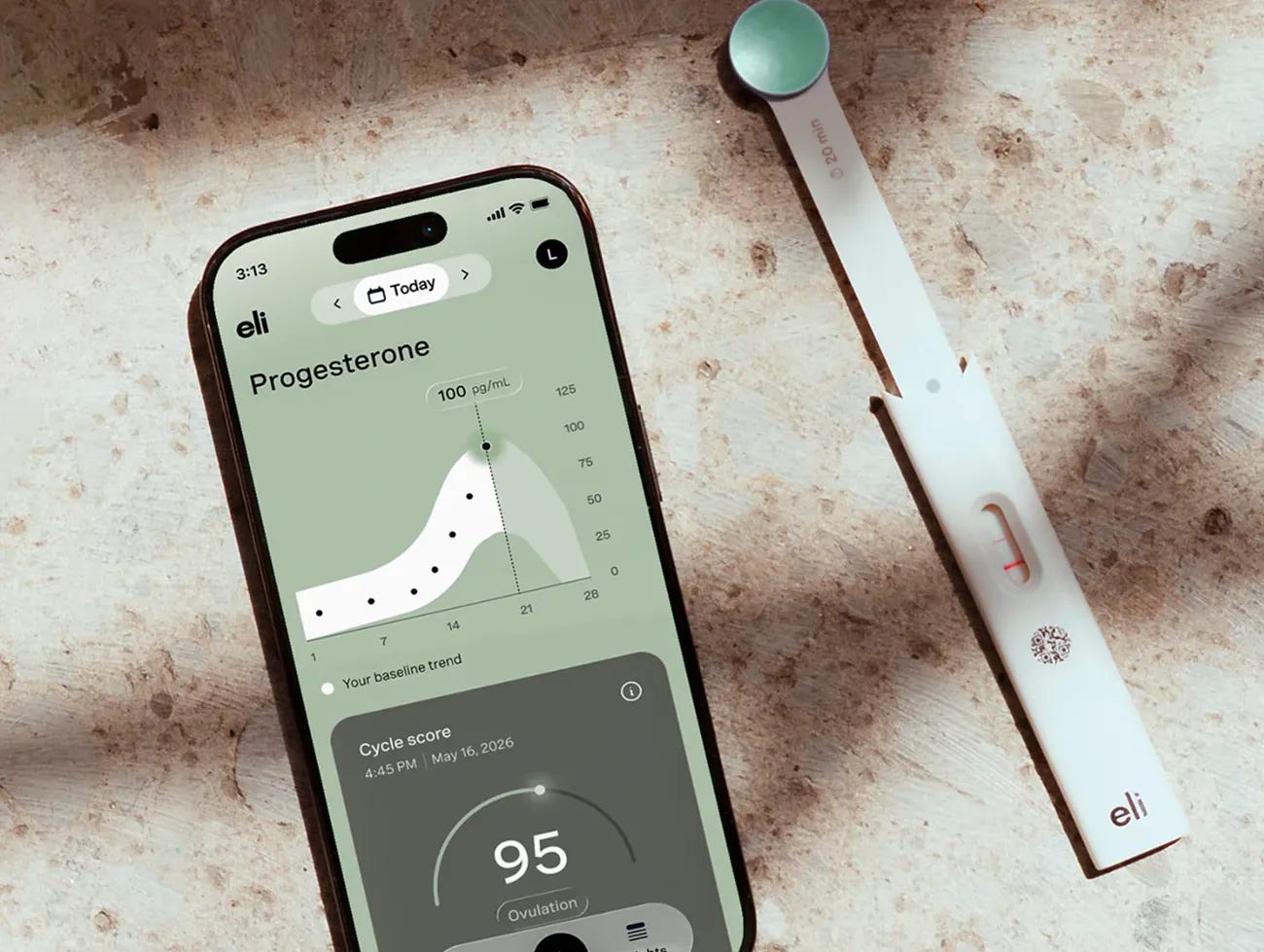
Canada’s Eli Health has announced an expansion of its saliva-based hormone testing platform, Hormometer™, opening pre-orders for real-time progesterone and testosterone test.
Hormones such as progesterone and testosterone influence energy, mood, fertility, metabolism and long-term health. Yet most people still access hormone data through infrequent lab tests that capture a single moment in systems that fluctuate daily. Eli Health’s proposition is to shift that model, using saliva-based tests that deliver results to a mobile app within minutes.
“What took weeks and a lab visit now happens anywhere in minutes,” said Marina Pavlovic Rivas, Co-founder and CEO of Eli Health.
“For the first time, people can measure testosterone instantly, pair it with real-time data on other hormones, and see how it fluctuates in response to daily life—including stress, sleep, training, and lifestyle interventions. That changes everything, from human performance to how people navigate fertility, metabolism, immune function, and more.”
Progesterone as an essential hormone
Progesterone plays a central role across the menstrual cycle and throughout life, influencing sleep, emotional regulation, menstrual regularity, fertility and the transition into perimenopause. Despite its importance, it remains difficult to monitor in practice.
Levels fluctuate rapidly and are highly timing-dependent. Blood tests typically require precisely scheduled lab visits, while most at-home options rely on urine-based testing designed for short-term fertility confirmation rather than longer-term insight. As a result, progesterone is often measured rarely, or not at all, outside specialist settings.
Eli Health’s Progesterone Hormometer™ is designed for frequent use. The saliva-based test allows users to measure progesterone at any point and track changes over time, with results displayed in the Eli app. The company argues that this approach makes it possible to observe patterns — how progesterone rises or fails to rise across cycles, or how levels shift during life stages such as perimenopause — rather than relying on isolated snapshots.
Testosterone as more than a male hormone
Testosterone affects far more than male sexual health. It plays a central role in energy, mood, metabolism, fertility, strength, bone density, athletic performance, and cognitive functions such as clarity, ambition, and decision-making in both women and men. Yet traditional testing captures only single snapshots—missing how testosterone evolves over time or responds to everyday behaviors and environment.
By making hormonal patterns visible continuously, Eli Health enables people to track progress, adjust everyday behaviors, and build a foundation for more informed health decisions over time.
Building a multi-hormone platform
The progesterone launch builds on Eli Health’s earlier release of a real-time cortisol test in 2025. The company now offers saliva-based testing for cortisol, progesterone and testosterone, positioning Hormometer™ as a multi-hormone platform rather than a single-use diagnostic.
According to Eli Health, third-party validation studies show the tests achieve over 90% accuracy compared with laboratory standards. Saliva is used because it reflects free, biologically active hormone levels and is already widely accepted in clinical research, while also being easier to collect frequently than blood.
The company says measuring multiple hormones together matters because they are closely interconnected. Cortisol dysregulation, for example, can suppress both progesterone and testosterone — relationships that are rarely captured when hormones are tested in isolation.
Pricing for tests begins at $8.25 per test with subscriptions and one-time purchase options available too.
In June 2025, Eli Health secured $12 million in Series A funding, in a round led by BDC Capital’s Thrive Venture Fund.