


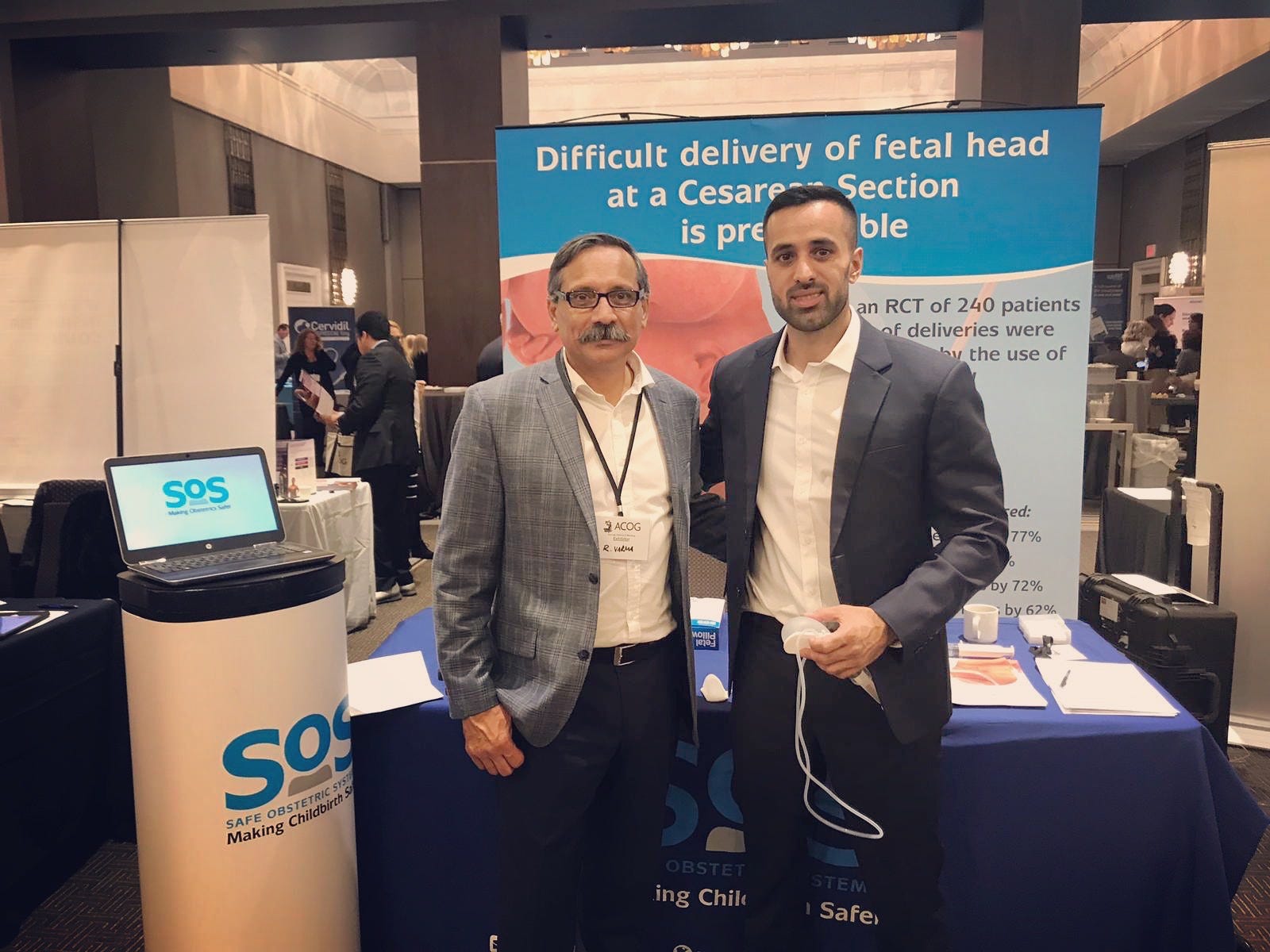
It was 2006 when a tragedy during a second-stage C-section left a lasting impression on obstetrician Dr Rajiv Varma. What followed was the development of a new obstetric device designed to make difficult deliveries less risky - and a decade-plus lesson in how women’s health innovations actually make it into real clinical use.
Dr Varma set up Safe Obstetric Systems to develop and commercialise Fetal Pillow, joined by his son and co-founder Nishant Varma who would lead its scale and expansion. By 2011, Fetal Pillow had launched into the UK’s NHS. From there, it expanded across Europe, the Middle East and Australasia, secured FDA clearance in 2017, and scaled across the U.S hospital system through direct sales, clinical champions and painstaking work with hospital purchasing committees.
Then, in 2021, the company was acquired by CooperSurgical, a global leader in women’s health and fertility.
It’s a success story with clear lessons for how evidence is built, how trust is earned and how adoption really happens.
A problem clinicians never forget
The Fetal Pillow device was designed after a catastrophic delivery involving an impacted fetal head - a scenario that is uncommon, but deeply distressing when it occurs.
“A lot of clinicians have ideas,” says Fetal Pillow co-founder Nishant Varma. “But bringing them to life — getting a prototype, regulatory approvals, clinical trials, bringing them to market — that’s where the real challenges start.”
But when Nishant and his father began showing early versions of the device to clinicians, something unexpected happened.
“When we started speaking to doctors in other hospitals, we realised it resonated immediately,” he says. “Almost everyone remembered a case similar to my father’s. It might have been five or ten years ago, but it was always described as terrifying.”
What also became clear was that the clinical burden was broad.
“Fetal trauma was thankfully, quite rare,” Nishant explains. “What happened more often were complications for the mother — uterine tears, blood loss, transfusions.”
That insight would later prove critical in shaping how the device was evaluated, justified, and adopted.
Fetal Pillow’s first commercial market was the NHS.
“Bringing an additional cost into the NHS is a real challenge,” Nishant says. “And every trust had its own budget. So it was hospital by hospital, clinician by clinician, then putting together a business case for each purchasing committee.”
Early on, there was little data and no reference sites. “If clinicians asked, ‘Is anyone else using this?’, we didn’t really have an answer,” he says. “Those first two years in the NHS were very, very tough. We were relying on clinicians to take a chance on something new.”
What helped to shift momentum was a combination of Nishant’s father’s clinical credibility and support from internal advocates - particularly nurses and midwives.
“In those difficult cases of fetal impaction, nurses or midwives were often asked to push the baby’s head from below,” Nishant recalls. “When we spoke to them, they told us how terrifying that was. They immediately saw how much safer this could be.”
After getting the first few hospitals and clinicians onboard the usage of the device began to spread. With that, outcomes improved and credibility followed.
The US is not just a bigger market
From the outset, Nishant saw the US as inevitable. “At the time, there were around 600,000 births a year in the NHS,” he says. “In the US, closer to 3.7 million. We knew the same problem existed — and that the impact could be much larger.”
After building clinical experience internationally, the team approached the FDA with several hundred real-world cases.
“There was no predicate device, so we had to go through the harder route - the De Novo pathway,” Nishant says. “That process took about 12 to 18 months of back-and-forth.”
When clearance came in late 2017, the real challenge began.
“Getting FDA clearance is one part,” he says. “Driving adoption in US hospitals is a completely different challenge.”
US hospital systems required a rigorous economic case.
“Value analysis committees are very focused on cost and outcomes,” Nishant explains. “If you can’t articulate the cost-benefit, it’s very difficult to get your device approved — no matter how good the technology is.”
Just as important was understanding how decisions are actually made.
“You need the right clinicians — usually department chairs or chiefs — involved early,” he says. “And even once a hospital approves the device, training, education and repeat usage are a whole separate effort.”
Again it was slow and painstaking work, but with breakthroughs along the way, particularly when Nishant was able to secure adoption with larger hospital groups rather than one by one at single sites.
Building relationships for acquisition
Then in 2021, after several years of US market activity, Fetal Pillow was acquired by CooperSurgical. To outsiders, the deal may have appeared sudden. Internally, it was anything but.
“People think CooperSurgical came out of the blue,” Nishant says. “In reality, we’d been building that relationship for several years.”
Those relationships began informally — often at conferences with CooperSurgical reps stopping by Fetal Pillow exhibition stands to find out how business was going — and deepened over time.
“Every year, we’d update them: FDA clearance, new clinical studies, new hospitals using the device,” he says. “They got to know us, and then they started hearing about Fetal Pillow from their own sales teams who were hearing about the device from clinicians directly.”
During diligence, the focus went far beyond revenue. “They drilled down to hospital-level data,” Nishant explains. “When did sites first order? When did they reorder? How often? Was the device becoming routine?”
Those questions taught Nishant another valuable lesson about what acquirers look for.
“They wanted to see that hospitals weren’t just trying it — they were embedding it. Selling a device into a hospital isn’t the most valuable data point — it’s whether it’s actually been adopted that matters”
From lived experience to OBG Access
After the acquisition, Nishant found himself fielding calls from founders facing similar challenges that he had spent the last ten years or more navigating.
“I realised this experience was quite unique,” he says. “Starting in the UK, selling into the NHS, then going into the US and selling directly into hospitals — it would be a shame not to share that.”
That insight led to the creation of OBG Access, a specialist consultancy supporting founder-led women’s health and obstetric device companies across three critical phases: launch readiness, US market activation, and scale-and-exit preparation.
Rather than offering high-level advice, Nishant positions OBG Access as a practical execution partner.
“A lot of founders underestimate how challenging it is to actually get adopted widely,” he says. “My role is to help them avoid learning everything the hard way — whether that’s building cost-benefit models, identifying the right clinicians, or understanding how US hospital systems really work.”
Over time, he began systematising what he had learned. During the US expansion, Nishant built detailed spreadsheets mapping hospitals by birth volume, identifying clinical decision-makers, and tracking where adoption was most likely to stick.
“There’s a lot of data out there if you know where to look,” he says. “Once you understand which hospitals matter and who actually makes decisions, you can be much more strategic about where you spend time.”
As for the Varmas, their work may not be finished yet either. Nishant shares that his father still keeps a notebook of ideas from years in clinical practice - some of which they may yet return to. “So,” he adds, “never say never.”
OBG Access works with a small number of founder-led women’s health device companies each year, providing execution-led support across NHS adoption, US hospital commercialisation, and acquisition readiness. Learn more at obgaccess.com or get in touch with Nishant directly at info@obgaccess.com.
Nishant Varma will be sharing his company’s story at Health2Tech in London on the evening of Tuesday 24 February. Register for free to join.
This article is a paid feature produced in partnership with OBG Access.