
Menstrual blood diagnostics in 2026: what's changing - and what we're tracking
FFHi - Brief: Why menstrual blood diagnostics are entering the mainstream — and what will determine whether they scale

For years, small groups of determined researchers, clinicians and founders have been working to destigmatise and normalise menstrual blood as a source of usable health data.
This month that conversation moved further into the mainstream. Reporting by the BBC on period blood testing as a potential alternative approach to HPV testing within cervical screening marks a moment when menstrual blood diagnostics stopped being framed as a distant idea and started being discussed as a serious public health option.
The significance isn’t that menstrual blood testing will replace cervical screening tomorrow — it won’t. For a start, the specific method discussed is only applicable to people who menstruate regularly, and the research remains early stage.
What is significant however, is that a national public broadcaster is treating menstrual effluent as a legitimate biospecimen that could one day potentially even be used by the NHS, worthy of serious discussion alongside established screening methods.
As we’ve seen with other historically stigmatised areas of health — including menopause — this kind of narrative shift matters. Mainstream awareness, clinical credibility and regulatory interest tend to move together, laying the groundwork for institutional and investor attention.
In the case of menstrual blood, the narrative is beginning to move from “period blood is waste” to “period blood is a potential source of clinical insight.”
And while public awareness may only now be catching up, a growing number of companies and research teams globally are already working with menstrual effluent to detect infection, hormonal signals, fertility markers, metabolic indicators and disease risk.
There are early signals of momentum. Qvin secured FDA clearance in 2024 for its menstrual pad–based diagnostic for diabetes, establishing an important regulatory precedent and sparking a number of media articles and deep dives into menstrual blood. Other teams have secured public funding, clinical pilots or early-stage investment to validate menstrual blood as a diagnostic input.
The question now is not whether menstrual blood can be used for diagnostics — but whether this approach will be adopted at scale, and which use cases and models are most likely to succeed.
Use cases: what menstrual blood diagnostics are — and aren’t — suited for
Menstrual blood is not a universal diagnostic solution. Different conditions vary widely in scientific readiness, regulatory complexity and clinical demand, meaning some applications are progressing faster than others.
Near-term and emerging use cases
These are areas where menstrual blood already shows promise as a practical diagnostic input, often because there is a clear clinical question and an existing comparator.
HPV screening
HPV, as referenced in the BBC article, is currently the most visible use case, in part because it aligns with existing cervical screening frameworks and has established follow-up pathways. If any use case will be the one to help menstrual blood diagnostics ‘break through’ it will be this one.Heavy menstrual bleeding (HMB)
Measuring blood loss or related markers could help quantify a condition that is widely under-diagnosed and often dismissed as subjective. In this use case, the biomarkers within the period blood aren’t the focus, but the analysis of the volume of the blood itself.Endometriosis screening and triage
While not a replacement for definitive diagnosis, menstrual blood may support earlier screening or risk stratification, helping to reduce diagnostic delays. Considering current diagnosis times stand at 8-10 years, this could be the use case with one of the most significant impacts.
Medium- to longer-term use cases in development
Beyond screening, some teams are exploring menstrual blood as a window into broader aspects of health. These applications are scientifically compelling, but may face higher validation and regulatory hurdles.
Hormonal health and cycle dynamics, particularly through longitudinal monitoring
Metabolic and inflammatory markers, where clinical relevance is still being established.
Sexual and reproductive health, including infections beyond HPV and fertility-related markers.
Cancer detection beyond HPV, which remains exploratory and long-term.
Not all use cases will mature at the same pace, and clarity of clinical purpose will be critical.
Companies and platforms we’re tracking
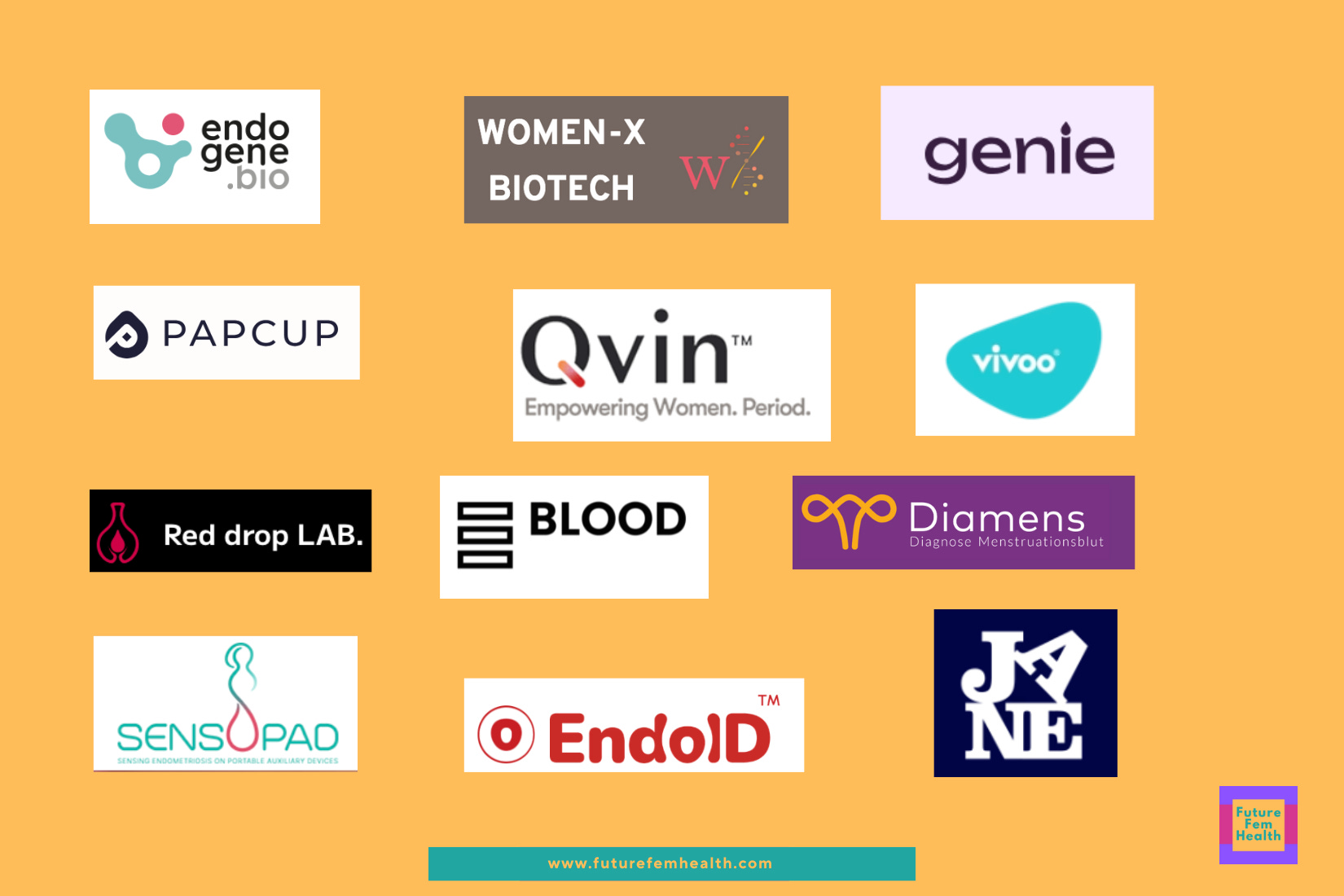
This is a non-exhaustive list (in no particular order), but reflects the range of approaches shaping progress in menstrual blood diagnostics today. Notably, it’s quite a global list, with significant representation outside of the U.S:
Qvin (U.S.) — The first FDA-cleared diagnostic menstrual pad, initially focused on diabetes management but with ambitions to expand into cervical cancer screening, endometriosis, STIs and uterine fibroids.
WomenX Biotech (Hong Kong) — Period-pad-based HPV testing with results within 3 business days. Currently undergoing clinical studies.
Genie Fertility (UK) — Developing a non-invasive menstrual blood test to inform fertility treatment; raised $1.22m pre-seed in 2025.
theblood (Germany) — Menstrual cup–based collection with an at-home testing ambition.
Red Drop Lab (Switzerland)— At-home self-sampling kit for non-invasive screening of STIs and vaginal microbiome.
Diamens (Austria) — Developing an at-home menstrual blood test for earlier endometriosis detection.
Sensopad — An EU-funded project working on sensor-equipped menstrual pads. It aims to detect endometriosis-related inflammatory proteins directly in the pad, without the need to post off a strip.
NextGen Jane (U.S) — Tampon-based menstrual effluent collection powering longitudinal research studies and diagnostics.
PapCup (UK) — At-home HPV testing using menstrual blood and swab collection. Student Sânziana Foia was awarded Innovate UK funding in 2025 under the BioMedical Catalyst.
Endogene.Bio (France) — detecting endometriosis using menstrual blood using a unique population of menstrual blood-derived stem cells known as MenSCs.
SYNG Pharma - A Canadian company exploring menstrual blood as a next-generation extension of its recently launched serum-based endometriosis detection test.
Vivoo (U.S) Already offering a range of at-home wellness tests, Vivoo announced at CES 2026 that it would be introducing the Vivoo FlowPad to turn menstrual pads into an at-home hormone test to measure follicle-stimulating hormone levels.
Other teams, including those who are exploring adjacent areas include:
Daye (UK), one of the most well-known brands in the space, Daye’s diagnostic tampon for HPV and STI self-sampling doesn’t use menstrual blood for testing, but it has set an important precedent for the adoption of tampon-based self-sampling and is currently on a three-year NHS pilot scheme too); CELLECT (Canada) HPV screening; Joii (Ireland), measures and monitors heavy menstrual bleeding; Quantiflow (U.S) A digital health system for measuring menstrual blood loss - a recent peer reviewed study highlighted the accuracy of its system; MenstruAI (Switzerland) a non-electronic device paired with app for ‘early warning system’; Lillypad Health (U.S) menstrual pad collection device for various health markers including HPV; TULIPON by GalsBio (Israel), a tampon diagnostic; Emm (UK) smart menstrual cup that measures flow volume); My Period Test (Germany) home testing of menstrual blood.
This is a non-exhaustive list and I’d love to hear other suggestions for who we should be tracking in the comments section.
A framework for tracking whether menstrual diagnostics will scale
Rather than just evaluating individual companies in isolation, we’re also tracking menstrual blood diagnostics through a set of category-level signals that indicate whether this field can move from pilots into scalable care.
1) Will people actually use it - and will it work in real life?
At-home testing is a clear tailwind, improving accessibility, privacy and convenience compared with venous blood draws or pelvic exams. But whether people choose to use — and keep using — a menstrual blood test depends on much more than availability.
People will compare menstrual blood tests not only with each other, but also with alternatives such as urine, blood, saliva and sweat-based tests - all of which continue to improve (and may not come with the same ‘baggage’ of taboo, stigma and embarrassment).
Key questions include how easy the test is to use, how clear the instructions are, and how restrictive the criteria are (for example, whether it only works on specific days of the cycle).
From a scaling perspective, tests also need to work in real-world conditions. If a sample only produces reliable results with perfect timing, refrigeration or very fast shipping, it will be hard to scale. Approaches that can tolerate average everyday use — delays, temperature changes and imperfect handling — are far more likely to succeed.
2) What’s being measured
Single-marker tests tend to reach market faster and follow clearer regulatory paths. Broader, multi-marker approaches may offer deeper insight, but face greater validation and regulatory complexity - and may not always give a value to users that feels immediately meaningful.
3) How often will it be used?
There will be a range of test types - for example one-off screening tests (such as an endometriosis triage) through to diagnostics that are designed for repeated use, such as fertility or hormone monitoring.
Longitudinal use cases offer the greatest opportunity to build defensible datasets over time - helping to also the gender data gap - while also supporting sustainable business models through repeat use.
4) Clinical validation
Accuracy alone will not be enough. Consumers and healthcare systems will want to see comparison against gold-standard methods, external validation and inclusive study design in order to determine credibility.
5) Regulation
Most menstrual diagnostics currently sit between “wellness insight” and regulated medical testing. Companies that pursue formal regulatory pathways may take longer to reach market, but are more likely to scale through healthcare systems.
6) Narrative shift and cultural destigmatisation
Scientific progress alone will not be enough to drive adoption. Like many areas of women’s health this category is educating, normalising and creating a market before it can sell a solution. That’s not easy for individual companies to do alone, particularly when you throw in the censorship of women’s health content to the mix too.
Historically, menstrual blood has been treated as waste or taboo, shaping everything from research priorities to patient willingness to engage. Mainstream coverage — such as the recent reporting by the BBC — helps reframe menstrual blood as a legitimate biospecimen rather than a fringe idea.
Until people understand why menstrual blood is valuable and begin to actively seek tests that use it, the market will be limited. Narrative change is a prerequisite for scale.
We’re tracking media coverage, public education efforts, clinician engagement and early institutional endorsement as leading indicators of whether menstrual diagnostics can move from technical possibility to mainstream adoption. Without this narrative shift, demand for these tests is likely to remain limited, regardless of scientific promise.
7) Inclusivity and access
Not all menstrual blood diagnostics will work for everyone. Some approaches — including those currently highlighted in the media — rely on regular menstrual cycles, excluding large groups such as people who are perimenopausal or menopausal, using certain contraceptives, or experiencing cycle disruption.
Pricing also matters: high-cost, consumer-only tests risk limiting access in the absence of reimbursement or public-health integration. We’re therefore tracking not just technical performance, but who can realistically use these tests at scale.
8) Funding and capital formation
One of the strongest signals to watch is whether companies are able to raise capital specifically for menstrual blood diagnostics. Dedicated funding — as opposed to bundled platform rounds — signals growing investor confidence that menstrual effluent can function as a legitimate diagnostic input.
9) What happens after a result?
As diagnostics move into the home, value is increasingly defined by what happens after a result is delivered. Solutions that support interpretation, referral and follow-up care are likely to outperform point solutions that stop at a result.
Why this matters
Menstrual blood diagnostics are no longer a fringe idea — but they are still a very early stage category. The next phase will be defined by whether the positive narrative around the category continues and whether we can see more by proof: validated use cases, regulatory clarity and evidence that people will use these tools repeatedly in real-world settings.
That’s why right now tracking how this field develops is as important as tracking who succeeds.
We’ll continue to share updates on this category in our weekly briefing FutureFemHealth - join 9,000+ subscribers globally via the sign-up below:


