


When England footballer Beth Mead tore her ACL just months before the Women’s World Cup, she became one of many elite female players sidelined by the same devastating knee injury. Across women’s sport, ACL tears have surged to alarming levels - a pattern that has exposed how little we know about female physiology and raised fundamental questions about how female athletes are trained, treated and understood in the future.
But the problem extends far beyond the pitch. Women of all ages experience higher rates of knee injuries and chronic knee pain - from recreational runners to peri- and post-menopausal women in everyday life managing rising osteoarthritis risk. Diagnosis is often slow and subjective, relying on clinicians observing movement with the naked eye rather than objective data.
That’s exactly where Emovi, a Canadian medtech company, comes in.
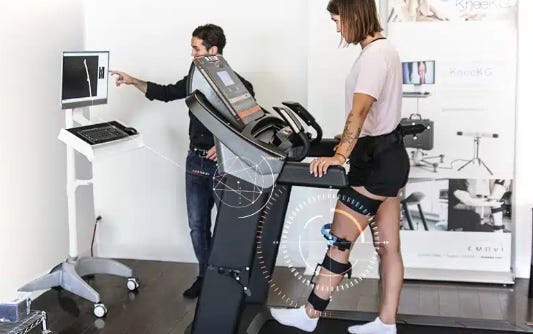
Its flagship technology, KneeKG, provides the first 3D motion analysis system capable of assessing how the knee behaves in real time — while walking, running, or climbing stairs — rather than relying only on static MRI or X-ray scans. The technology was first developed for osteoarthritis care, where long surgical waitlists and limited imaging left clinicians without enough information to guide treatment.
Now beyond that role it also offers a much more precise understanding of joint movement that can help clinicians spot weaknesses early and personalise rehabilitation in ways traditional assessments can’t.
“What’s most empowering,” says Bianca Marois, a kinesiologist and R&D project manager at Emovi, “is that patients can see exactly how their knee moves. It gives them control — they leave the clinic understanding what’s happening and what they can do about it.”
Moving beyond the limits of static imaging
Traditional imaging shows structure, not movement. Emovi’s KneeKG system, by contrast, records a patient’s gait and knee motion using sensors placed on anatomical landmarks, producing a dynamic 3D model of the joint in action.
“It’s like an EKG (electrocardiogram) for the knee,” says Yann Lamarche, Emovi’s General Director for Europe.
“We look at the signature of movement. Every knee has a pattern, and when that pattern shifts — when the knee turns inwards, or loads abnormally — that’s when injury risk increases.”
The ten-minute test is conducted while a patient walks on a treadmill. Data from the movement generates a detailed report highlighting biomechanical abnormalities that may lead to ligament tears, cartilage damage, or early osteoarthritis. Clinicians can then prescribe targeted strengthening exercises, adjust rehabilitation plans, or monitor recovery progress.
“Women are up to four times more likely than men to experience ACL injuries,” continues Bianca.
“I was one of them. I played basketball at a high level, tore my ACL, had surgery — and even after rehab, I struggled to come back. If I’d had access to this technology, I might have understood my risks earlier.”
From sports injuries to everyday pain
While sports performance has been the most visible use case, the implications extend far beyond professional athletes. As populations age, the number of people requiring knee replacements — particularly women — is expected to rise by more than 130% by 2030.
Older women are already more likely than men to develop knee pain and osteoarthritis.
“We can identify biomechanical weaknesses that may contribute to chronic pain or future joint issues,” says Yann. “That early insight is an opportunity for intervention.”
A global rollout and a growing women’s health focus
Originally spun out of the University of Montréal, Emovi’s KneeKG technology is now used in more than 80 clinics worldwide, including in Canada, the U.S., France and the UK, where Bupa has already begun reimbursing the service through private insurance.
The company is now working on a digital platform to extend its reach — allowing patients to track their rehabilitation remotely and giving clinicians tools to monitor progress between visits. An upcoming Series D round of funding will support this work.
London is one of the next expansion targets, where the team hopes to tailor the digital experience specifically for women’s health and sports-injury prevention.
“We want to create a full patient journey,” says Yann. “From diagnosis to digital follow-up — making the process more personal, more preventive, and ultimately more equitable.”
For Bianca, who sees women of all ages come through her clinic — from teenage footballers to 60-year-olds managing knee pain — the impact is already tangible.
“When patients understand their movement, they’re doing more than recovering,” she says. “They’re reclaiming confidence in their bodies.”
Emovi is one of nine startups selected for the 2025 Canadian Technology Accelerator (CTA) FemTech program organised by the Government of Canada. This program is free for the selected participants, and it provides access to mentors, a peer network, masterclasses delivered by subject matter experts on topics like the market landscape, IP considerations, fund raising, regulatory issues, public relations, and more, and a dedicated visit to the UK and France to connect founders with potential partners and customers. This article is part of a partnership with the High Commission Canada in the UK.