


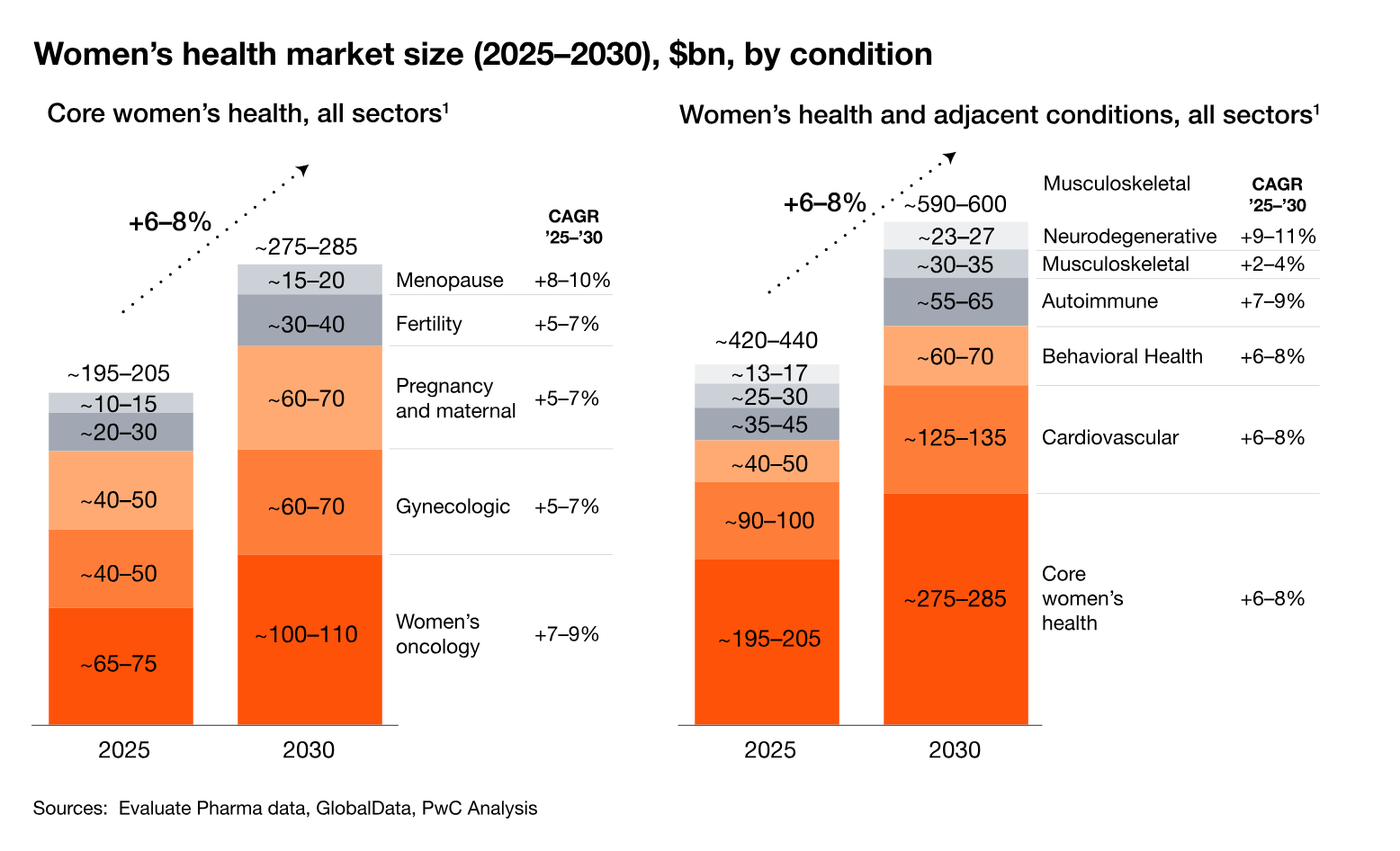
Women’s health is on track to become one of the most significant growth markets in global healthcare - projected to exceed $600 billion by 2030, according to a new report from PwC.
The analysis positions women’s health as a broad, undercapitalised segment spanning the full life course - from adolescence through to later life - and encompassing both sex-specific conditions and those that affect women differently or disproportionately.
PwC argues that current gaps in research and investment funding reflect a “structural inefficiency in how healthcare markets have been defined and funded.”
A broader definition - and a bigger market
PwC estimates that today’s women’s health market - across pharmaceuticals, devices and diagnostics, care delivery, and consumer health - sits at roughly $430–440 billion globally. That figure is now expected to grow at a compound annual rate of 6–8% to reach more than $600 billion by the end of the decade.
To estimate this market size PwC has used a broader definition of women’s health than has typically been used in market analyses.
Within that, “core” women’s health segments - including fertility, maternal health, gynecological conditions, menopause, and women’s oncology - account for approximately $195–205 billion today, projected to rise to $270–280 billion by 2030.
By including conditions such as cardiovascular disease, autoimmune disorders, neurodegenerative conditions, and mental health - areas where women experience different symptoms, disease progression, or outcomes - PwC expands the scope of what constitutes the women’s health market, and with it, the size of the opportunity.
Framing women’s health as a longitudinal, life-course market - rather than a series of episodic interventions - reveals the unmet need and new commercial potential.
Growth driven by unmet need and new models
PwC points to several converging drivers behind the market expansion.
Growth is being driven by a combination of clinical innovation and shifting care models. Areas such as women’s oncology and menopause are gaining momentum, while high-burden conditions like autoimmune disease - where women represent up to 70–80% of patients - are benefiting from new therapeutics. At the same time, digital platforms, at-home diagnostics, and AI-enabled tools are accelerating a shift toward more continuous, consumer-driven care.
Consumer health technology alone is projected to grow at 14–17% annually, significantly outpacing more traditional segments.
Capital begins to follow
Investment trends suggest that capital is starting to respond to the opportunity.
Between 2020 and 2025, nearly $60 billion flowed into core women’s health segments across venture capital, private equity, and corporate investment, according to the report. While early funding concentrated heavily in fertility and reproductive care, capital is now diversifying into areas such as menopause, oncology, diagnostics, and broader chronic conditions.
Different investor groups are approaching the market in distinct ways. Private equity firms are focusing on scaling provider platforms and consolidating fragmented care delivery, particularly in fertility and gynecology. Venture capital is targeting technology-driven models, including digital health and AI-enabled diagnostics. Corporate investors, meanwhile, are investing in adjacencies aligned with existing pharmaceutical, medtech, and payer businesses.
A market still taking shape
Yet even as headline figures grow, the boundaries of the women’s health market remain fluid.
Estimates vary widely depending on how the category is defined. Some analyses place the market in the single-digit billions, while others extend into the hundreds of billions.
Suncoast Ventures’ Mark Gannott, together with Thalassea Partners, recently compiled an industry analysis - aggregating 55 reports across nine thematic sections and eight research firms. The resource highlights just how wide that range can be, with headline figures spanning from $9 billion to $267 billion. By surfacing definitions, base years, and methodologies side by side, it shows that market sizing in women’s health is fundamentally about how you classify it.
PwC’s $600B projection does not contradict these estimates so much as reflect a category that is still being actively defined and expanded. And, the report itself suggests the upside may be larger still:
“As underdiagnosed conditions are better identified, as sex-specific R&D expands, and as digital, AI-enabled and consumer-directed models scale, entirely new revenue pools may emerge, suggesting that the addressable market for women’s health could extend beyond today’s forecast.”
Overall, the report suggests that women’s health is moving from the margins toward the centre of healthcare strategy - and with commercial opportunity at the core.