


Welcome to issue #163 of FutureFemHealth (w/c September 14 2026) — your weekly briefing on the global women’s health market.
Evvy’s $40m Series B is undoubtedly the headline this week - a huge milestone for the company, the vaginal health category and a big win for women’s health. But, there’s been plenty more happening too...
🌟 In this week’s briefing:
🔥 Evvy raises $40m Series B to take its vaginal microbiome platform further into women’s health
💊 Eli Lilly looks to women’s health as GLP-1 revenues fuel its next bets
📈 Wisp targets broader women’s health platform after reaching 2m patients
🤰 $100m committed to tackling US maternal mortality
Share your news: anna@futurefemhealth.com
💰 Capital flows

📌 US: Evvy raises $40m Series B to take its vaginal microbiome platform further into women’s health. From launching in 2021 in one of the more taboo and overlooked corners of women’s health, to now raising an oversubscribed $40m Series B, Evvy has reached a stage relatively few companies in the sector have reached. Its vaginal microbiome platform has now served more than 100,000 patients and 3,000 practitioners, building what Evvy says is the world’s largest proprietary clinical-grade dataset in the field. Now, it wants to use that data and its EvvyAI platform to develop new diagnostic and care models across fertility, preterm birth, cervical cancer, endometriosis and PCOS, with fertility first. Catalio Capital Management led the round, joined by new investors including US Fertility Innovation Fund, Rethink Impact, Muse Capital and Alumni Ventures. (Continue reading: FutureFemHealth)
👀 Coming this week on FutureFemHealth Pro: What’s next for the vaginal microbiome market? Evvy’s $40m Series B marks a major milestone, but the market is moving well beyond testing alone. This week I’m looking at where the investment has gone, how the market is evolving across diagnostics, fertility, therapeutics and care - and where the next opportunities could emerge. Upgrade to Pro to get the full analysis when it lands later this week.
📌 AUSTRIA: Aitiologic raises €6.4m seed to advance first-trimester preeclampsia risk test. Could an existing prenatal blood draw tell us more about the health of the mother too? Vienna-based Aitiologic is developing a liquid biopsy platform that aims to identify women at increased risk of preeclampsia using the same first-trimester blood sample already taken for NIPT. Earlier feasibility work found the approach could stratify risk for both preterm and term preeclampsia, with the company now validating the technology in a study of more than 1,000 pregnancies. The oversubscribed round was co-led by European health VCs Heal Capital and Ananda Impact Ventures, while Oxford Nanopore co-founder and former CEO Gordon Sanghera also invested and has joined Aitiologic’s advisory board. (Continue reading: FutureFemHealth)
👀 ICYMI on FutureFemHealth Pro: Diagnostic double-ups. Aitiologic is another example of a trend we’ve been tracking: what if the next women’s health diagnostic doesn’t require another test? Companies are finding ways to extract additional insights from samples, scans and tests already embedded in routine care – from mammograms being used to assess cardiovascular and osteoporosis risk to Pap samples being explored for ovarian cancer detection. Read our analysis of the companies building the diagnostic ‘double-up’.
📌 CHINA: ANDPERIOD raises multi-million yuan angel round to scale premium menstrual care brand. Thought period care was maxed out on innovation? Well, here is ANDPERIOD, developing products specifically for women with sensitive skin through a new patented surface layer designed to be softer and avoid chemical additives. The funding will take the product into mass production, with a Pre-A round already underway. (Continue reading: PEDaily)
📌 US: Viv raises $2m as period care continues to attract investment. ANDPERIOD isn’t the only period care brand attracting fresh capital this week. Viv is also betting there’s room to rethink the materials and design of period products. Its new patented Cottonlock tampon uses a protective veil designed to prevent cotton fibres being left behind after removal. The round will fund its launch alongside a major retail expansion, with 11 Viv products rolling out across all 526 Whole Foods stores in the US. Launchpad Venture Group, Next Phase Capital, Westchester Angels and Creator Venture Fund among the investors. (Continue reading: FutureFemHealth)
📌 US: Merck KGaA/EMD Serono acquires two PostEra fertility drug programmes targeting needle-free ovarian stimulation. IVF is still very dependent on injectable medications - not exactly pleasant or convenient for patients. But we’re seeing a spate of innovation aimed at changing that. Just last week, Australia’s GonGlobal raised A$1m to develop tech for delivering existing IVF medicines through inhalation. Now, a major incumbent in fertility pharma is buying into the idea of an all-oral IVF regimen. PostEra’s two preclinical programmes are developing small-molecule alternatives to injectable FSH and hCG treatments. (Continue reading: PostEra)
🌟 Industry moves and strategic shifts
📌 US: Eli Lilly appears to be building a bigger women’s health business. Bloomberg reports that Lilly is using some of its GLP-1 windfall to build capabilities across women’s health, hiring reproductive health expertise and targeting areas including preeclampsia, bone health and endometriosis. It has already invested $40m in Absci’s endometriosis programme and is exploring women’s health indications across its obesity portfolio. No big strategy announcement yet, but the pieces are certainly being put in place. (Continue reading: Business of Fashion / Bloomberg)
📌 US: Wisp targets broader women’s health platform after reaching 2m patients. Moving beyond the sexual and reproductive health services on which it built its business, Wisp is expanding across fertility, diagnostics, menopause and longer-term health and wellness. It’s a strategy we’re increasingly seeing across women’s health, as companies built around one need or life stage expand across ages, stages and conditions to build longer-term patient relationships. Wisp, which acquired sexual health provider TBD Health in January, has also appointed DTC executive Keira Krausz as CEO to lead its next phase, with the ambition of becoming a “continuous health-span companion”. (Continue reading: FutureFemHealth)
📌 US: Good Clean Clinical Care launches microbiome-first vaginal health platform. In the same month as Evvy’s $40m Series B, Good Clean Clinical Care has launched with microbiome testing, specialist telehealth and personalised treatment for women with chronic or recurring symptoms. It’s another sign of the market moving beyond testing alone towards diagnosis, treatment and ongoing care.(Continue reading: Good Clean Clinical Care)
📌 US: Midi Health makes retail debut with Ulta Beauty as the lines between healthcare and wellness continue to blur. Best known for virtual menopause and midlife care, Midi is taking five of its supplements into more than 300 Ulta Beauty stores this month, including products for GLP-1 support, brain health and cortisol. It’s Ulta’s first partnership with a dedicated women’s healthcare platform — an interesting example of the blurring boundaries at both ends, as women’s health companies expand into everyday wellness and beauty retailers move further into health. (Continue reading: Midi Health)
📌 GLOBAL: New FemTech ecosystem data to bookmark. Lots of useful ecosystem data and insights out this month - catch up on FemTech Association Asia’s overview of the Southeast Asia market; FemTech Spain’s ecosystem map; and the Eir Accelerator Finland ecosystem map
🩸 Research and women’s health news

📌 US: $100m initiative aims to halve US maternal mortality by 2031. A new bipartisan campaign is putting $100m over five years behind approaches already shown to improve maternal outcomes, with a goal of halving US maternal mortality by 2031. Healthy Moms, Healthy Babies America will focus on rural maternity care, midwifery, postpartum support and maternal and infant data infrastructure, using states as the main route to scale successful programmes. The initiative also hopes to attract matching public and private capital. “The goal is to prove that this works and then have state funding take it over,” said co-founder and philanthropist Olivia Walton. (Continue reading: Abc News)
📌 US: NIH puts $21m behind sex-specific models for drug development. We still use many drugs that weren’t developed with a clear understanding of how dosing, effectiveness or toxicity might differ for women. NIH is now funding researchers to build computational models — including AI and digital twins — that simulate how hormonal changes across women’s lives affect treatment response. The aim is to give researchers better sex-specific tools for testing drugs and developing more precise treatments. (Continue reading: NIH)
📌 GLOBAL: New white paper makes the business case for better menopause education. Just 6.8% of family medicine, internal medicine and OB/GYN residents in one US study felt prepared to manage menopause - a knowledge gap that physician and medical educator Lara Zibners and physician and business professor Adam Brown argue carries wider economic costs. Their new white paper cites an estimated $25bn in annual direct medical expenses associated with menopause symptoms among US women aged 45–60, alongside $1.8bn in lost work days. It calls for menopause to be integrated across medical school teaching - from cardiovascular to musculoskeletal health - before doctors specialise, rather than treated as a standalone or primarily gynaecological issue. (Continue reading: FutureFemHealth)
📄 Policy watch: risks and opportunities
📌 AUSTRALIA: Government invests A$25m in access to affordable contraception. Eight new Long-Acting Reversible Contraception Centres of Excellence will operate across every Australian state and territory from October, offering free contraceptive advice alongside IUD and implant insertion and removal. The centres will also train clinicians and extend outreach into regional, rural and remote communities. (Continue reading: Ministers Gov Au)
📆 Save the date
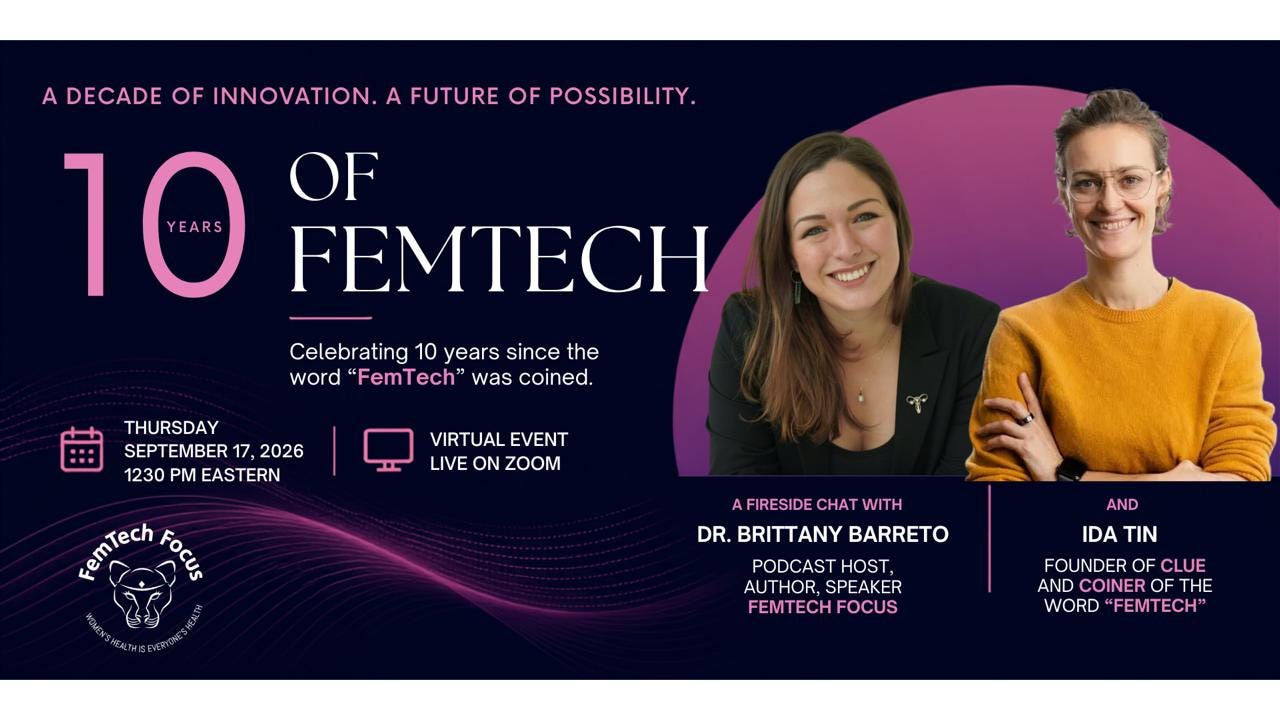
📌 10 Years of FemTech: A Fireside Chat with Ida Tin: virtual, September 17. Ten years after Ida Tin coined the term FemTech, she will join FemTech Focus founder Dr Brittany Barreto to discuss where the category began, how it has evolved and what its next decade should look like. Includes a live audience Q&A too! 🎟️ Register here.
✅ Win 1 of 3 tickets to the Women’s Health Horizons London Summit…
I’m teaming up with Women’s Health Horizons to give FutureFemHealth readers a chance to win one of three complimentary tickets to its London summit on Monday 22 September. Head over to this LinkedIn post to enter the competition!
That’s all for this week! If you’ve missed any previous briefings catch them all at futurefemhealth.com and do make sure to follow us on LinkedIn and you can connect with me directly on LinkedIn.
Anna
