


Over the past three months I’ve tracked every women’s health funding round I’ve been able to verify globally.
Today, I’m publishing the results: a complete Q2 women’s health funding analysis, the first application of the FutureFemHealth Classification Framework, and a downloadable tracker of every funding round I verified this quarter.
Let’s get into it!….
But first, a note on the data: Figures are based on FutureFemHealth’s quarterly funding tracker and represent the data available at the time of publication. We are currently undertaking a full-year reconciliation using FFH Intelligence (FFHi), our expanded methodology and structured women’s health funding dataset. This includes transaction-level validation, deduplication and updated classification of qualifying women’s health investment. Historical quarterly figures may therefore be revised. Final reconciled 2026 data and analysis will be published in early 2027. For more information, please get in touch: anna@futurefemhealth.com
So, what happened in women’s health funding this quarter?
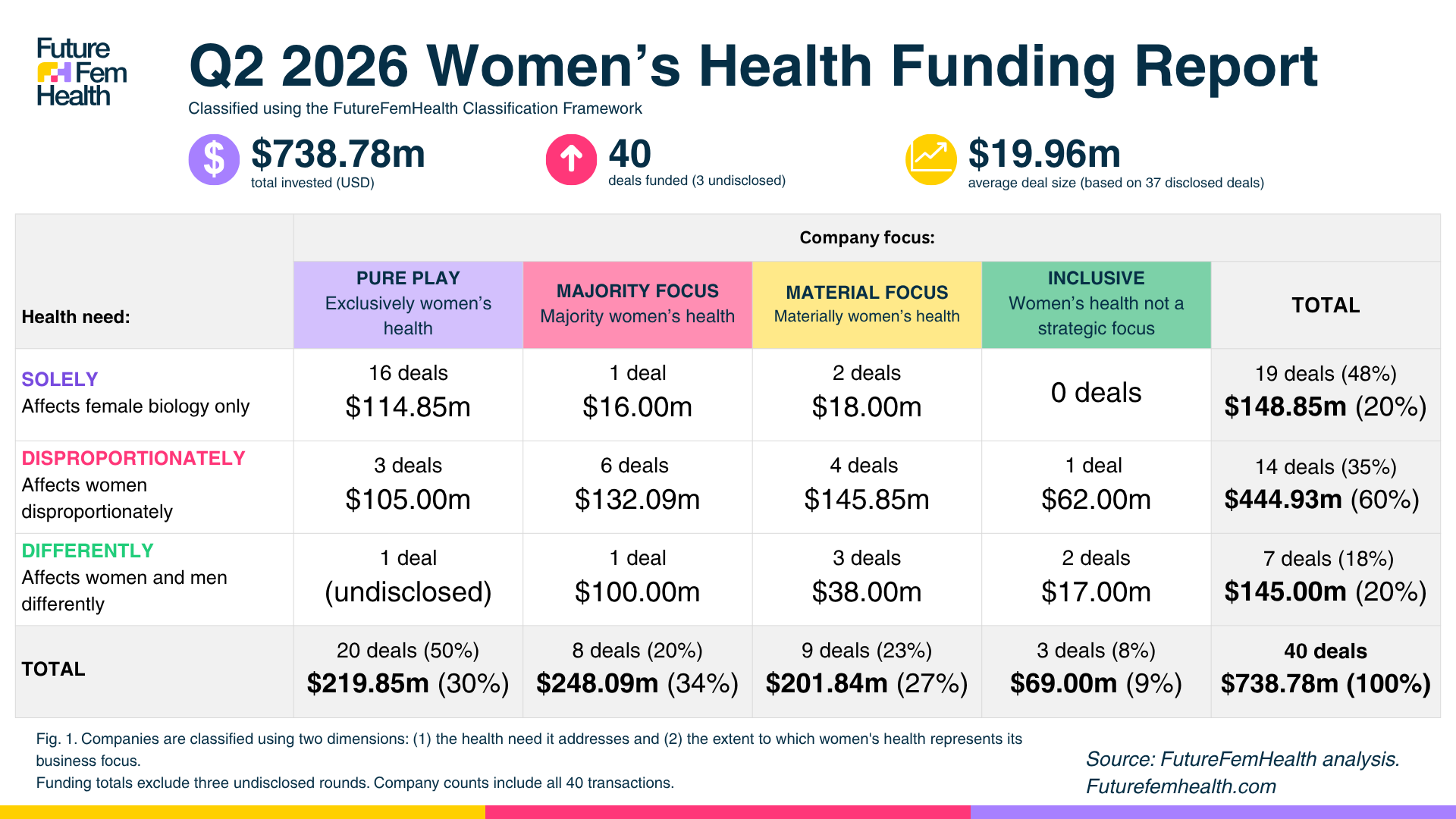
FutureFemHealth has tracked US$738.78 million invested across 40 women’s health funding rounds during Q2 2026.
The average disclosed deal size was $19.96 million (based on 37 disclosed deals), with the largest investments going to CREATE Medicines ($122m) for its autoimmune platform and Nourish ($100m) for its virtual metabolic health clinic.
What’s interesting is that neither of these companies is a pure play women’s health business. Nor are they focused solely on female-specific health conditions.
Yet together they accounted for 30% of all funding tracked this quarter.
These are exactly the kinds of companies that challenge the way we measure women’s health investment.
Include them and the headline funding figure for women’s health tells a very different story. Exclude them, however, and we miss substantial investment into companies intentionally improving women’s health.
That’s why this quarter marks the first application of the FutureFemHealth Classification Framework.
Rather than asking simply whether a company is or isn’t women’s health, the framework considers two questions:
What health need is being addressed?
How much of the company’s business is genuinely focused on women’s health?
Together, they provide a more complete and nuanced picture of where capital is actually flowing.
In the full analysis, you’ll find:
Why 60% of funding flowed into conditions that disproportionately affect women rather than female-specific conditions.
Why the biggest funding rounds are increasingly emerging beyond traditional women’s health categories.
Why data and infrastructure are becoming some of the most valuable assets in women’s health.
Where the next decade of innovation is beginning to take shape.
The boundary decisions behind the FutureFemHealth Classification Framework—including metabolic health and male contraception.
Below, FutureFemHealth Pro members can read the full analysis and download the complete Q2 tracker, including every deal, its classification and my notes on each company.