



A guest post by Anastasiya Markvarde
Women’s hormonal health has been staggeringly underestimated. It’s not hard to see why: research in women’s health still focuses heavily on fertility and pregnancy as the primary lens. And it’s that narrow framing which shapes everything - from what gets funded, to what gets measured, since it’s much harder to innovate without accurate data as a basis.
Case in point: only 12% of all scientific journals on gynecology and obstetrics are dedicated to women’s health issues unrelated to their reproductive role. A mere 4% deal with the health of women before and after their reproductive years.
But female hormones aren’t just important for reproductive health.
While this is no doubt an area of great importance, female hormones also profoundly influence cardiovascular, neurological, cognitive, immune, and oral health across the entire lifespan. And because hormones fluctuate hourly, daily, and across life stages, many of the health effects we care about can only be understood through patterns - not just single-point tests.
This article explore what current research reveals about the wider hormonal effects and why innovators are now racing to fill the knowledge and care gap. We share an overview of the emerging hormonal health technologies - from saliva-based trackers to next-gen wearables - and what to expect in 2026 and beyond.
How female hormones impact women far beyond reproduction
There are a number of examples of research highlighting the broader impacts of female hormones. Examples include:
Breast cancer: Sex hormone concentrations were strongly associated with several established or suspected risk factors for breast cancer, and may mediate the effects of these factors on breast cancer risk (cross-sectional analyses of breast cancer risk factors and circulating hormone concentrations in more than 6000 postmenopausal women controls in 13 prospective studies).
Heart health: While the cardiovascular protective effects of estrogen are well-established, less is known about the effects of testosterone and cardiovascular disease risk. Multiple studies found that higher testosterone/estradiol (T/E2) ratio is associated with elevated cardiovascular disease risk in postmenopausal women. In postmenopausal diabetic women, low free testosterone is associated with increased cardiovascular mortality.
Oral health: Among postmenopausal women, higher free testosterone was associated with a greater prevalence of tooth loss. Periodontal disease is exacerbated by estrogen deficiency, leading to alveolar bone loss and increased tooth mobility.
Autoimmune disease: There is clear evidence for the role of sex steroids in the immune disturbances that result in autoimmune diseases.
Alzheimer’s: Steroid hormones affect both neurons and glia, thus affecting the risk and resilience for Alzheimer’s.
Parkinson’s: Exposure to estrogen level fluctuations across the lifespan of women correlates with the higher risk of Parkinson’s.
ADHD: Emerging research reveals profound hormonal influences on ADHD in women. A systematic review found that 98% of women with ADHD reported cognitive and mood changes corresponding to hormonal fluctuations. ADHD symptoms worsen during mid-luteal and menstrual phases when estrogen is low.
Gut health: There is a connection between gut bacteria and sex hormones: certain gut bacteria produce gas that stimulates other bacteria to convert glucocorticoids, a type of steroid, into progestins, however, the exact mechanisms by which gut bacteria modify these hormones and the resultant impact on health are not well understood.
Sleep and memory: Hormones play important roles in altering both sleep and memory performance across the adult female lifespan. Sex hormone fluctuations may mediate or moderate the relationship between sleep and memory changes, but more quality studies are needed to understand the exact mechanisms and impact on health.
Anxiety and depression: Women are at twice the risk for anxiety and depression as men, with sex hormone fluctuation as a major biological factor.
Innovative solutions for female hormone health
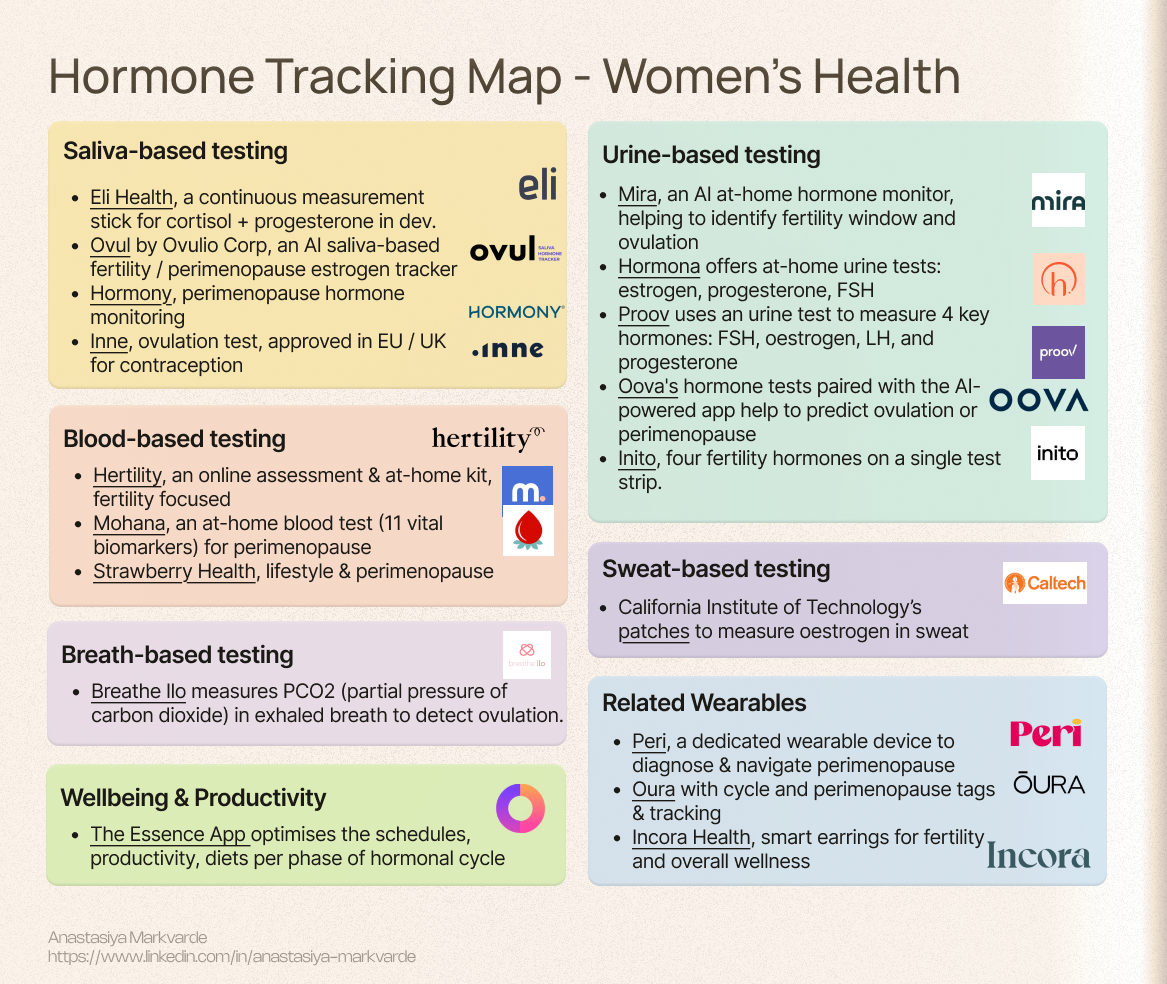
To address this vast women’s hormonal health gap, innovative solutions are emerging. Startups in the area are allowing women to track previously inaccessible data. At-home tests have experienced rapid growth, while the emerging and most transformative shift is towards continuous or high-frequency tracking - these are technologies capable of capturing hormone dynamics in real time, not just snapshots.
Below you will find a map* of hormonal tracking startups and wearables, showing the potential of this market segment. In fact, hormonal health is the fastest growing femtech vertical in Europe, according to the European Femtech Map by Femtech Italy.
*the map is non-exhaustive but rather provides an overview of some of the existing solutions.
Saliva-based testing:
Inne, Germany / UK (raised €18.8M, Series A + extension) a hormone tracker, via an at-home saliva test predicts and confirms ovulation. Achieved regulatory milestone: first saliva-based contraception certified in UK and Europe (June 2025)
Eli Health, Canada (raised $12M in June 2025, total funding close to $20M) provides real-time insights into hormone levels through a saliva-testing stick, which can be continuously tracked over time to the difference of single-point tests. Currently focused on cortisol, with progesterone, testosterone and estradiol in the roadmap. Eli Health’s Hormometer won CES 2025 “Best of Innovation in Digital Health” award.
Ovulio Corp, Ovul, US / Ukraine, an AI-powered, saliva-based fertility tracker designed to assist women in monitoring their ovulation cycles. The device analyzes saliva samples to detect crystallization patterns that change throughout the menstrual cycle due to fluctuations of estrogen. Ovul launched Estrogen Trend Indicator on iOS in May 2025, expanding beyond fertility to perimenopause/menopause tracking.
Hormony, Singapore, measures estrogen, progesterone, and FSH through rapid at-home saliva tests specifically designed for perimenopause tracking.
Urine-based testing:
Mira, US, an FDA and CE registered numeric estrogen and luteinizing hormone test. With the validated 77% ovulation prediction accuracy by fourth cycle, Mira uses the same fluorescence-based technology found in labs to measure LH, E3G, PdG, and FSH with 99% accuracy. Named a 2026 CES Innovation Award Honoree.
Hormona, UK / Sweden, ($6.7M in seed funding in 2025) is pioneering at-home urine testing for estrogen, progesterone, and FSH. Their proprietary tests achieve over 90% accuracy compared to venous blood sampling and provide results in under 15 minutes. The company uses AI to analyze long-term hormone patterns for conditions like PCOS, irregular cycles, and perimenopause. Hormona collected over 2M health data points from users in 185+ countries since its 2023 launch and joined forces with Space X to track hormones of women in space.
Oova, US (raised $10.3m in 2023, Series A) hormone tests paired with the AI-powered smartphone app provide daily quantitative of L, E3G (a metabolite of estrogen), and PdG (a metabolite of progesterone) levels to track and predict ovulation or perimenopause. The company has a perimenopause kit that measures hormone fluctuations across a 15-day period, providing insights unavailable from FSH-only tests.
Inito, India/US (raised $6M in 2023, Series A) measures four fertility hormones - LH, E3G (estrogen metabolite), PdG (progesterone metabolite), and FSH- on a single test strip. It’s designed to work with both regular and irregular cycles
Proov’s, US (raised $9.7m in 2021, Series A) peri-menopause test measures four key hormones FSH, oestrogen, LH, and progesterone, while their ovulation test measures pregnanediol-3a-glucuronide (PdG), a urine metabolite of progesterone, to confirm successful ovulation.
Blood-based testing:
Hertility, UK (raised total of $16.3M as of May 2025) has an advanced hormonal kit which measures up to 10 hormones. The startup provides a personalised hormone panel after an online assessment.
Mohana, Canada, is a precision health platform to help women in perimenopause feel better and navigate this transition through an at-home blood test (11 vital biomarkers) and a personalised plan.
Strawberry Health, US, offers 9 key hormone biomarkers, using a special automatic blood-draw device.
Sweat-based testing:
California Institute of Technology’s patches (at the research stage) could measure estradiol (oestrogen) in sweat.
Breath-based testing:
Breathe Ilo, Austria, measures PCO2 (partial pressure of carbon dioxide) in exhaled breath to detect ovulation. Women experience a type of hyperventilation 4-5 days before ovulation, causing CO2 levels to drop.
Wearables:
Level Zero, UK, (raised $6.6M in 2025) a wearable with DNA-based biosensors from interstitial fluid for 4 key hormones: progesterone, estrogen, cortisol, testosterone. The startup has validated its biosensors with 98% accuracy across the human clinical range, surpassing industry standards.
While not directly measuring hormones, other wearables in-market provide insights on menstrual cycle and (peri)menopause by tracking symptoms and temperature together with other parameters. These include:
Oura, US / Finland, ($900M Series E in 2025) smart ring introduced cycle tracking and perimenopause tags to track the symptoms, including sleep. Released a perimenopause report
Peri, Ireland, (raised €1.4M), a wearable biosensor that fits neatly under the breast to detect and track peri-menopausal symptoms with an app to guide women through perimenopause. Four sensors provide information on hot flushes, night sweats and anxiety levels. Released a perimenopause report
Incora Health, US (undisclosed funding) tracks key health metrics like core body temperature, heart rate variability, oxygen saturation, and respiration rate using smart earrings. The technology analyzes this data, combined with menstrual cycle tracking, to provide personalized insights for optimizing overall wellness, fertility, stress management, and sleep quality.
More novel technologies are being developed in this segment, for example, MoleSense with its molecular wearables - a new class of medical devices that go beyond tracking vital signs to continuously and non-invasively monitor biochemical markers such as proteins and hormones.
Wellbeing / productivity hormonal tracking:
The Essence App (raised $600K from Berkeley SkyDeck Fund and others) optimises the schedules, fitness routines, and diets of women as per each phase of their hormonal cycle. Essence claims to be able to boost women’s performance by up to 33%.
Conclusion
The field of hormonal tech is moving ahead rapidly with all of these different types of innovations, many of which have emerged just in the past 5 years. They signal the shft from hormone tracking ‘just’ as a fertility tool to hormone understanding as a real cornerstone of our overall lifelong women’s health.
The next challenge and opportunity will be in what happens beyond measurement. The industry needs solid clinical validation, consumer and clinical adoption, and integration into care pathways. We need to translate continuous hormonal insights into actual guidance, treatment and behaviour change beyond just tracking.
Love this!