Welcome to issue #158 of FutureFemHealth, (w/c August 10 2026) - your weekly briefing on the global women’s health market.
Confidence in women’s health has shown up in a few different ways this week: we have specialist capital returning for a second fund, an established OTC company going all-in on the category, and new evidence that HRT use is finally starting to move.
🌟 In this week’s briefing:
💰 $58M first close for Cross-Border Impact Ventures’ women’s and children’s health fund
🧫 A “uterus in a dish” to speed up women’s health drug development
💊 Plan B owner completes transition to pure-play women’s health company
📈 Hormone therapy use nearly doubles since 2017
Share your news: anna@futurefemhealth.com
This week’s newsletter is powered by TrialMe

TrialMe is hosting an in-person patient recruitment event at the Nordic Tech Week focused on women's health, where attendees learn about active trials, ask questions, and complete on-site pre-screening for eligibility. If your organization runs health studies in Sweden, reach out to Hanna Kalesse at hanna.kalesse@trialme.eu to discuss collaborating.
Let's make clinical research more accessible, understandable, and patient-centered.
💰 Capital flows
📌 CANADA: Cross-Border Impact Ventures raises $58 million first close for second women’s and children’s health fund. Investing at the critical Series A and B stage, where many women’s health companies struggle to secure follow-on funding, Cross-Border Impact Ventures is targeting US$125 million in total at final close. Building on its US$90.3 million debut fund, which has already delivered its first strategic exit and provided early validation of its investment thesis, Fund II will continue backing medical devices, diagnostics, therapeutics and digital health, while adding a climate lens to its investment strategy. (Continue reading: CBIV)
📌 US: Opal Therapeutics awarded $1.25 million to tackle a bottleneck in women’s health drug development. Animal models often fail to accurately replicate conditions such as endometriosis and uterine fibroids, adding to the push for better alternatives to animal testing. Opal is developing a “uterus in a dish” using cells collected from menstrual blood and surgical tissue, allowing researchers to test potential drugs on models of real human tissue much earlier in development. The National Science Foundation (NSF) award will help Opal expand the platform and build a database to better predict how potential treatments might work. (Continue reading: Opal Therapeutics)
📌 US: Ouma Health expands high-risk pregnancy network through acquisition. As access to high-risk pregnancy specialists shrinks in many communities, Ouma Health is building a national network that combines telemedicine with local specialist care. Its latest acquisition of a multi-site New England practice expands that network, helping more women with high-risk pregnancies access expert care closer to home. This news is timely too, as new March of Dimes data out this week shows one in three US counties still has no obstetric clinician or facility at all. (Continue reading: City Biz)
🌟 Industry moves and strategic shifts
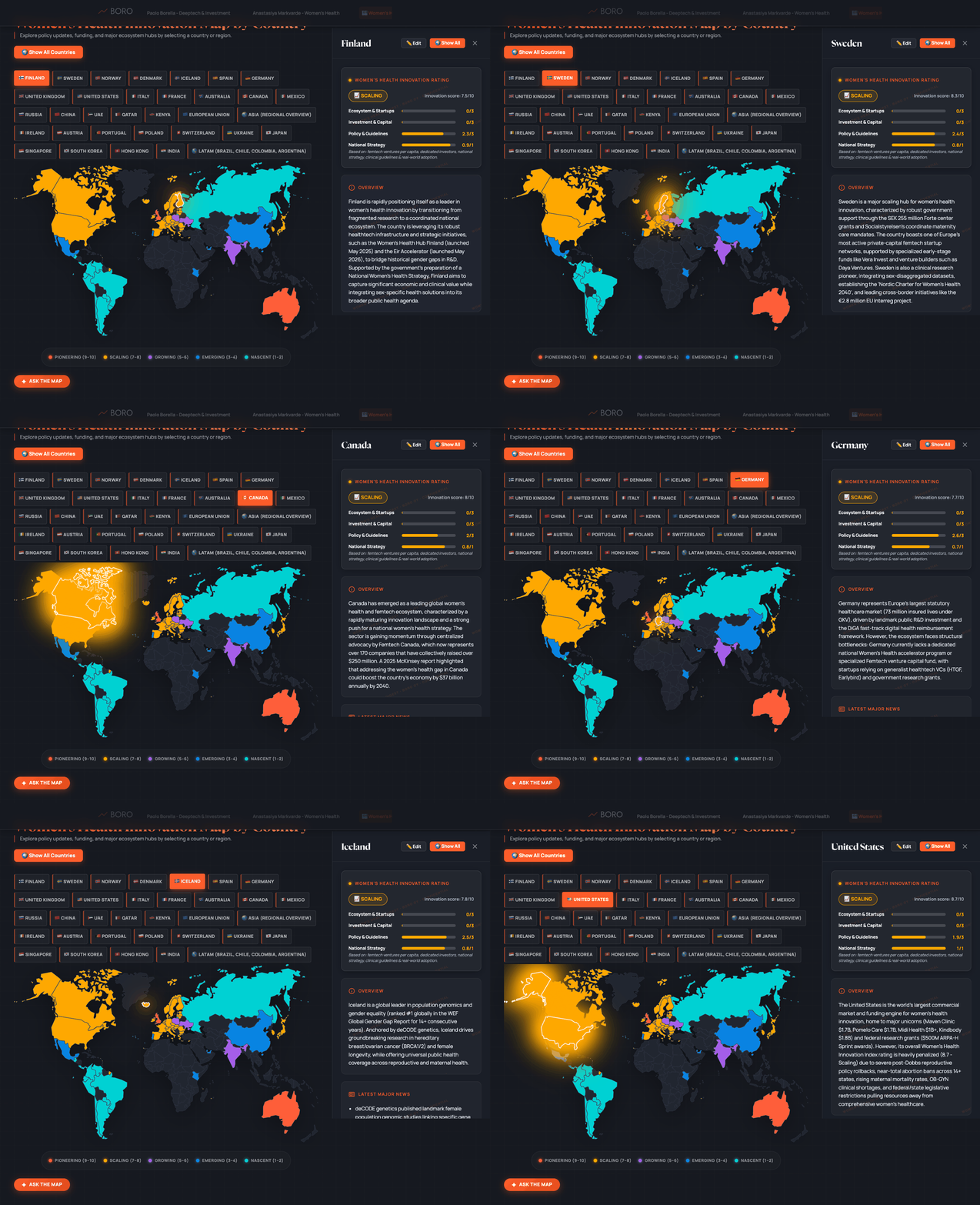
📌 GLOBAL: New map argues ecosystem maturity matters as much as funding in women’s health. In a new analysis for FutureFemHealth, women’s health strategist Anastasiya Markvarde argues that the strongest innovation ecosystems are built on more than capital alone. Her Women’s Health Innovation Map, which assesses 33 markets, highlights the importance of aligning national strategy, policy, specialist investors and founder communities to help innovation reach patients. The UK, Australia and the Nordic countries emerged among the most coordinated ecosystems, while the US stood out for scale but scored lower on coordination due to its fragmented healthcare and policy landscape. (Continue reading: FutureFemHealth)
📌 US: Plan B owner Foundation Consumer Healthcare completes transition to a pure-play women’s health company. Foundation Consumer sold its broader OTC wellness brands in June, and has now completely repositioned around women’s health, centred on its Plan B emergency contraception business. It’s another sign of the confidence building around women’s health as a market, with an established healthcare company choosing to specialise rather than diversify across multiple categories. Former Haleon executive Rupa Bahri has just been appointed CEO to lead the next phase of growth. (Continue reading: Foundation Consumer Healthcare)
📌 UK: Calla Lily joins Wellcome Leap’s US$50 million programme to develop targeted UTI treatment. Women aged 16–54 are prescribed almost 40% more antibiotics than men, driven in part by the high prevalence of UTIs. Now women’s health company Calla Lily Clinical Care has been selected for Wellcome Leap’s Focused Antibiotics programme to test whether its vaginal drug-delivery platform can deliver antibiotics while largely avoiding the gut, potentially reducing the wider effects that contribute to antibiotic resistance. Originally developed for fertility and pregnancy treatments, the project also shows how technology built specifically for women could have applications far beyond reproductive health. (Continue reading: Calla Lily Clinical Care)
📌 US: Clair Health joins Mayo Clinic programme to strengthen clinical evidence behind its hormone wearable. Clair Health has been one of the most talked-about wearable companies in women’s health this year - particularly because of its approach to continuous hormone monitoring. Now, ahead of shipping its first devices in December, Clair Health has joined Mayo Clinic Platform_Accelerate, giving it access to millions of de-identified clinical records to develop and validate its AI models. Clair will test whether its models can reliably identify things like ovulation, irregular cycles and the perimenopause transition, and ultimately provide useful insights for women and clinicians. (Continue reading: FutureFemHealth)
📌GLOBAL: Oura patent points to future monitoring of pregnancy complications. Oura’s women’s health ambitions look set to broaden further, with a new patent exploring how its wearable data could help identify serious pregnancy complications. The newly uncovered patent describes using wearable biometrics to monitor changes in blood pressure and arterial stiffness, potentially flagging warning signs of conditions such as preeclampsia. In higher-risk scenarios, data could even be shared directly with healthcare providers. It’s not yet a confirmed product, but provides another signal of Oura’s ambitions to move wearables deeper into clinical women’s health. (Continue reading: Wareable)
📌 UK: FemTech founders among Innovate UK’s largest ever Women in Innovation cohort. Maternal health startups Megi Health and Peripear as well as at-home HPV test Papcup are among the winners of the 10th annual Innovate UK awards. Megi Health’s Dr Frances Conti-Ramsden has been awarded £75,000 to run a study testing whether smartphone-based vital signs and data capture could help monitor cardiovascular health and improve pregnancy outcomes. (Continue reading: UKRI)
🔒 FutureFemHealth Pro
FutureFemHealth Pro offers a growing library of proprietary women’s health market intelligence, including quarterly funding analyses, M&A research, market maps and in-depth sector reports.
Recent reports include:
What women’s health should be watching on peptides
Q2 2026 Women’s Health Funding Analysis
H1 2026 Women’s Health M&A Analysis
The GLP-1 Support Economy
The emerging ‘pre-IVF’ market
Urinary health
🩸 Research and women’s health news
📌 US: Hormone therapy use nearly doubles since 2017, with growth accelerating in recent years. New analysis of US outpatient data found use rose from 1.7% of women in 2017 to 3.6% by April 2026. Overall use is still incredibly low, but what’s interesting is that most of the increase has happened since 2023, with use among women aged 45–54 nearly tripling. It suggests greater menopause awareness and changing perceptions of the original Women’s Health Initiative findings may finally be rebuilding confidence in hormone therapy. And with the FDA only removing longstanding safety warnings in November 2025, we might yet see uptake climb further. (Continue reading: Epic Research)
📌 US: DEXA scans for osteoporosis fall 35% despite remaining the gold standard for screening. Use of the bone-density scans is going backwards, with new analysis of more than 5.2 million Medicare beneficiaries finding a 35.4% decline between 2005 and 2023 - despite improvements in access over that period. Researchers don’t yet know what’s driving the fall, but declines were particularly large among Hispanic patients and people living in more deprived areas. With routine osteoporosis screening recommended for women aged 65+, it highlights another important gap in preventative care for older women. (Continue reading: Radiology Business)
📄 Policy watch: risks and opportunities
📌 US: Illinois becomes one of the first states to introduce menopause workplace protections. From 2027, women experiencing menopause-related symptoms will have new protections against discrimination and rights to reasonable workplace adjustments. Following similar moves in Rhode Island and Philadelphia, Illinois will also introduce new insurance coverage requirements for menopause care from 2028. (Continue reading: JD Supra)
📆 Save the date

Grounded: A meditation for the femtech community. Virtual, August 19.
The work of improving women’s health is meaningful - but it can also be demanding. Join this hour of guided meditation to pour a little back into yourself. Led by Lisbeth Garassino and Dr Brittany Barreto. No meditation experience needed.
That’s all for this week! If you’ve missed any previous newsletter issues catch them all at futurefemhealth.com and do make sure to follow us on LinkedIn and you can connect with me directly.
Anna