Welcome to issue #147 of FutureFemHealth, (w/c May 18 2026) - the global weekly briefing on women’s health innovation.
A milestone for our CensHERship campaign this week as the issue of women’s health censorship will be debated in Parliament! I’ll share more details on what’s discussed next week.
🌟 In this week’s briefing:
💧 UroMems raises $60m for smart implant for stress urinary incontinence
🤖 Evvy launches AI advisor built on vaginal microbiome data
🎨 How women’s health branding grew up
🧫 March of Dimes initiates preterm birth prevention microbiome trial
Share your news anna@futurefemhealth.com
This week’s newsletter is powered by BOLD LIP

In women’s health, clarity is what makes trust possible. BOLD LIP is the branding agency built exclusively for women’s health organizations, helping them launch, evolve, and grow with branding that audiences understand and stakeholders believe in. Through strategy, messaging, design, and digital experience, BOLD LIP builds brand systems that strengthen your impact.
💰 Capital flows
📌 FRANCE: UroMems raises $60m to advance smart implant for stress urinary incontinence. Women suffer from SUI at higher rates than men with risk factors including age and pregnancy. Current treatment options are sometimes only partially effective. UroMems’ automated artificial urinary sphincter is designed to treat SUI in both women and men - it adjusts automatically based on patient activity, aiming to make it easier to use and with less complications than existing surgical options. The raise follows promising female clinical feasibility results reported last year, where a small group of women all successfully reached six-month endpoints with no revision surgeries or device removals needed. This strategic investment came from Ajax Health Fund and followed UroMems’ Series C in 2024. (Continue reading: UroMems)
📌 US: BlueWind Medical raises $47.8m to expand commercialisation of its Revi implant for urge urinary incontinence (UUI). Another major urinary incontinence raise this week, as BlueWind Medical’s minimally invasive system secures funding to scale sales and market access. The implant works through a device near the ankle that stimulates the tibial nerve to help reduce bladder leakage and overactive bladder symptoms. Just last month, the company published three-year clinical data showing 79% of women maintained a 50% or greater reduction in UUI episodes, with no device-related serious adverse events reported. The equity and debt funding will support broader rollout of the FDA-cleared device. (Continue reading: Medical Device Network)
📌 AUSTRALIA: NinaMED launches with $13.75m for overactive bladder therapy. And a third pelvic health and incontinence funding story this week for medtech company NinaMED and its non-invasive, at-home neuromodulation device for overactive bladder (OAB) as a drug-free alternative to existing treatments. The company has secured exclusive global rights to the “NiNA System” and this funding - led by SPRIM Global Investments - will support clinical development, regulatory pathways and global commercialisation efforts. (Continue reading: BioPharma APAC)
📌 US: CREATE Medicines has raised $122m to advance its in vivo CAR-T platform across autoimmune disease and oncology, including programmes in breast cancer. CREATE develops therapies designed to engineer immune cells directly inside the body rather than through traditional lab-based manufacturing, with a pipeline spanning cancer and autoimmune conditions. The raise reflects growing momentum behind advanced immunology approaches in autoimmune disease. (Continue reading: CREATE)
📌 US: Autoimmunity BioSolutions closes $1m seed extension. Traditional autoimmune treatments broadly suppress the immune system, but Autoimmunity BioSolutions is developing genetically targeted therapies targeting patients with a genetic variation linked to more severe autoimmune disease and poorer treatment response. The company has now expanded its seed round to $3.1m as it continues to develop more personalised treatments for autoimmune diseases including rheumatoid arthritis and lupus (both of which disproportionately impact women) as well as type 1 diabetes. The financing was anchored by Eos BioInnovation. (Continue reading: Pulse 2.0)
🌟 Industry moves and strategic shifts

📌 US: Evvy launches AI advisor built on vaginal microbiome data. “EvvyAI” is built on data from more than 100,000 vaginal microbiome tests and will help users navigate vaginal health, fertility and menopause through personalised AI guidance. It’s another example of companies in women’s health using AI as the interpretation layer that sits between diagnostics, data and ongoing care. (Continue reading: FutureFemHealth)
📌 US: Carrot expands AI-powered metabolic health programme, Sprints, into menopause care. There’s growing interest in the role metabolic health may play in symptoms including sleep disruption, fatigue, weight changes and stress during perimenopause and menopause - alongside broader demand for more continuous and personalised menopause support. The Sprint platform combines guidance across nutrition, movement, sleep and stress with wearable device integrations and AI-driven recommendations designed to adapt to symptoms, lifestyle and health goals over time. Carrot says the programme is designed to help address gaps in menopause education and ongoing support, with more than 80% of women reporting they do not feel informed about menopause or available care options. (Continue reading: Carrot)
📌 US: Gatorade launches women’s hydration research initiative. Major consumer brands continue to align themselves with the growing interest in women’s sports, performance and hormonal health. This multi-year research initiative will focus on women’s hydration and nutrition across life stages including menstruation, pregnancy and perimenopause. The programme - called “Body of Science” - aims to address the lack of female-specific sports science research. Gatorade says only 6% of sports science research focuses exclusively on women. Around 500 women have already participated in early studies, with Venus Williams joining as an ambassador. (Continue reading: PepsiCo)
💡 Perspectives

📌 How women’s health branding grew up. Women’s health branding is moving beyond euphemistic wellness aesthetics and into a more confident, evidence-led era. In this feature, we explore how brands are combining clinical credibility, consumer-grade design and honest relatability - alongside the rise of “evidence branding”, more direct healthcare language and emotionally intelligent design. Featuring insights from BOLD LIP, Bummed and Salus Global on why healthcare branding is becoming more human, more specific and more clinically confident. (Continue reading: FutureFemHealth)
🩸 Research and women’s health news
📌 US/UK: March of Dimes initiates preterm birth clinical trial. If successful, this therapy being trialled in partnership with Imperial College London could become one of the first new preventative approaches for preterm birth in decades. Researchers believe microbiome-related inflammation may contribute to up to 40% of preterm births, making the vaginal microbiome an increasingly important area of maternal health research. The trial will test whether a vaginal live biotherapeutic containing “good bacteria” can reduce rates of preterm birth in high-risk women. Earlier feasibility data suggests a 50% reduction in preterm birth rates among women receiving the therapy. (Continue reading: March of Dimes)
📌 GLOBAL: New research suggests osteoporosis may increase mortality risk in postmenopausal women by as much as 47%. A study of nearly 3,000 women found lower bone mineral density in the femur was associated not only with higher fracture risk, but also higher overall risk of death - reinforcing growing recognition of osteoporosis as a broader systemic health issue rather than simply a bone condition. Researchers say the findings, published in the The Menopause Society journal, highlight the importance of early screening, weight-bearing exercise and preventative menopause care as global osteoporosis rates continue to rise. (Continue reading: Menopause)
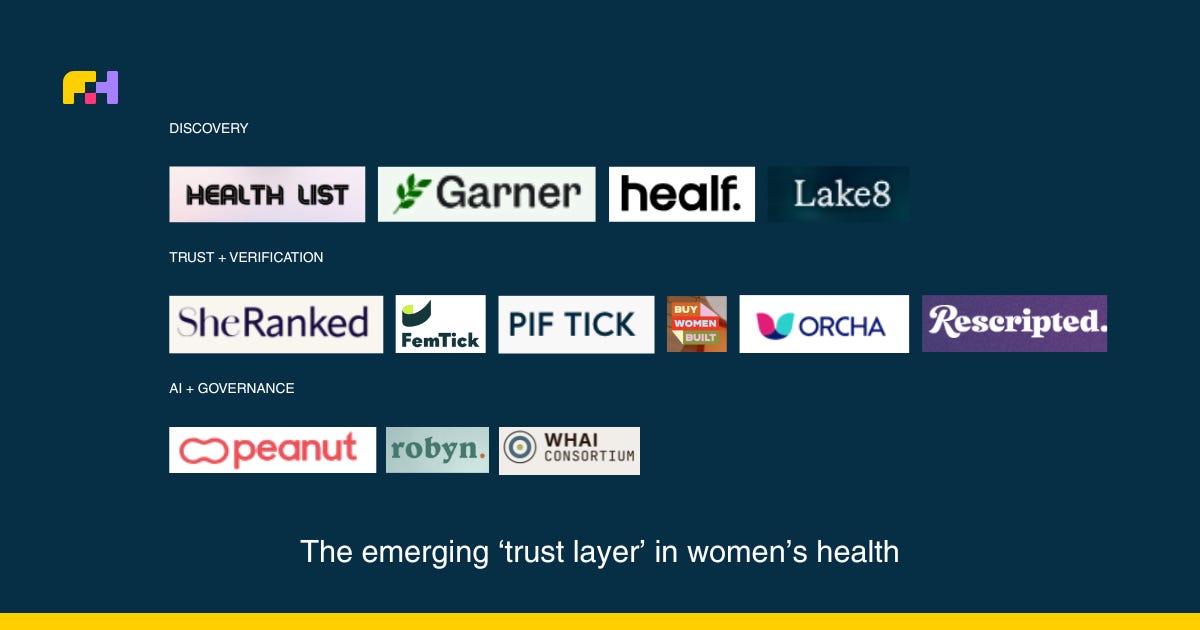
Did you miss our latest FutureFemHealth Pro feature?
Last week’s FutureFemHealth Pro deep dive explored the rise of a new “trust layer” in women’s health - from AI governance and verification systems through to discovery infrastructure shaping how women find and evaluate health information.
It’s a theme we’ll continue to track over the coming weeks and months, particularly around AI interpretation, credibility and trusted healthcare navigation.

FutureFemHealth now offers FutureFemHealth Pro - our new paid layer focused on deeper analysis on where women’s health is going.
Founders, investors, operators and leaders across the space are already joining FFH Pro and you can explore our first pieces: our Q1 funding tracker and key signals, the emerging ‘trust layer’ in women’s health, or our feature on the bone health market.
Find out more and join FutureFemHealth Pro for more analysis behind the headlines:
📆 Save the date

📌AUSTRALIA: Breaking the silos: the women’s health medtech summit. Sydney, May 27-28. This inaugural event is dedicated to addressing long-standing gaps in research, innovation, and policy affecting women’s health in Australia. The program brings together leading voices shaping the national conversation on women’s health in MedTech - spanning media, policy, research, and industry - to drive real system change.
🎟️ Tickets here.
That’s all for this week! If you’ve missed any previous newsletter issues catch them all at futurefemhealth.com and do make sure to follow us on LinkedIn and you can connect with me directly.
Anna