


Welcome to issue #139 FutureFemHealth, (w/c March 23 2026) - the global weekly briefing on women’s health innovation.
I’m back in London this week - heading to the House of Lords for an event tonight all about the Women’s Health Strategy refresh.
🌟 In this week’s briefing:
🔥 The $600 billion women’s health market - new PwC report
🌎 Global women’s health stalls despite rise in screening, latest Hologic Index finds
💰 Endometrics awarded nearly $1m by NIH for endometriosis diagnostics
✅ €12.5m funding backs new approach to chronic pain treatment
Share your news for a future issue: anna@futurefemhealth.com
🔥 The opportunity is still bigger than we know - new PwC report sizes women’s health market at $600 billion by 2030.
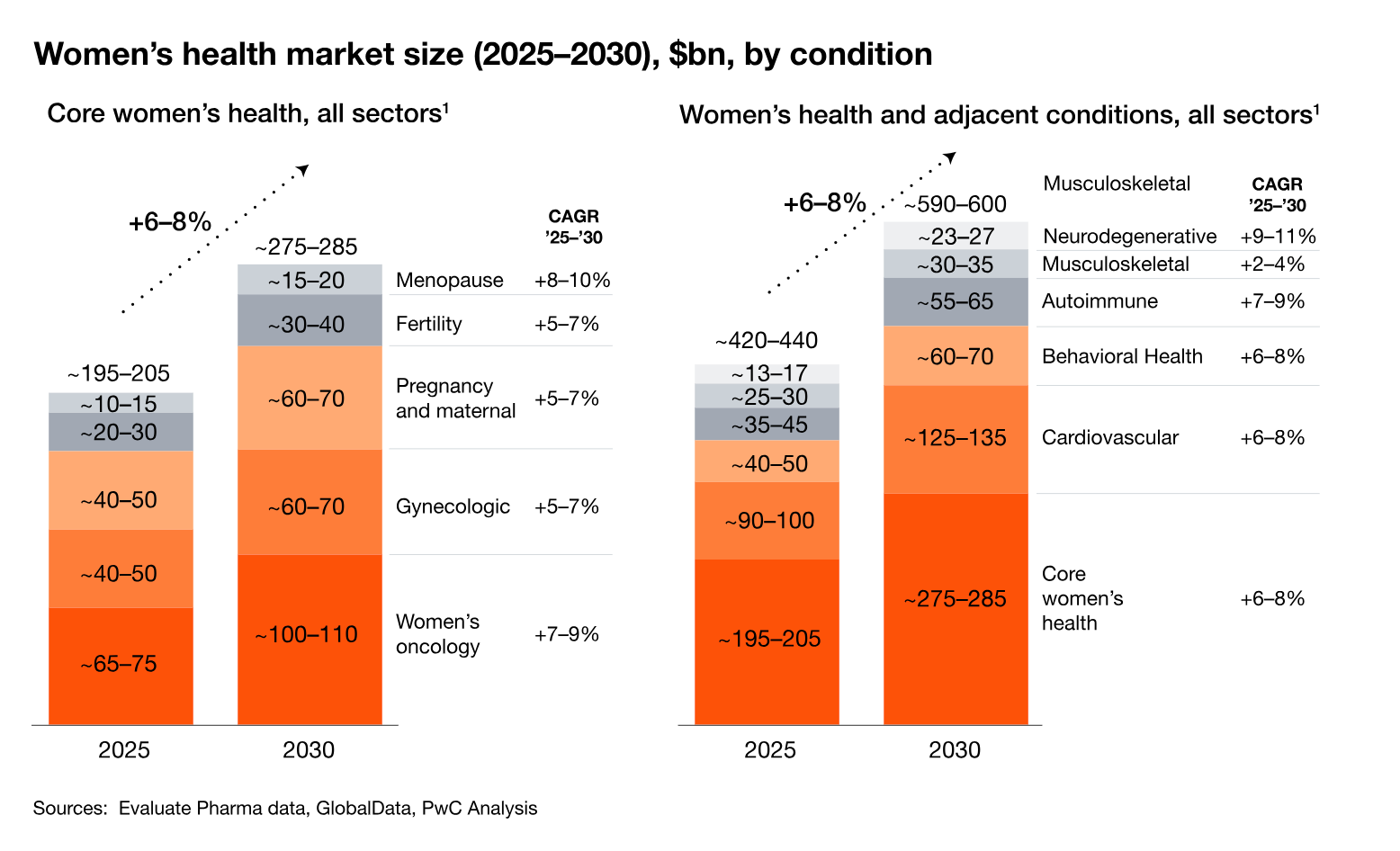
PwC just sized the women’s health market at $600 billion by 2030 - and even that may be an underestimate.
In a new report, the global firm reframes women’s health as a life-course market, spanning adolescence through to later life and extending far beyond reproductive care.
By using a broader definition of women’s health than was once the case - incorporating conditions such as cardiovascular disease, autoimmune disorder and mental health- PwC estimates the market at $430-440 billion today growing at 6-8% annually.
Within that, “core” women’s health segments - including fertility, maternal health, gynecological conditions, menopause, and women’s oncology - account for approximately $195–205 billion today, projected to rise to $270–280 billion by 2030.
But, the report itself suggests the upside may be larger still:
“As underdiagnosed conditions are better identified, as sex-specific R&D expands, and as digital, AI-enabled and consumer-directed models scale, entirely new revenue pools may emerge, suggesting that the addressable market for women’s health could extend beyond today’s forecast.”
And while it can still feel like many investors do not yet fully grasp the opportunity, the PwC report says that investment trends suggest that capital is starting to respond to the opportunity.
Nearly $60 billion has already flowed into core segments since 2020, with capital now expanding beyond fertility into menopause, oncology, diagnostics and chronic disease.
Different investor groups are approaching the market in distinct ways:
Private equity firms are focusing on scaling provider platforms and consolidating fragmented care delivery, particularly in fertility and gynecology.
Venture capital is targeting technology-driven models, including digital health and AI-enabled diagnostics.
Corporate investors, meanwhile, are investing in adjacencies aligned with existing pharmaceutical, medtech, and payer businesses.
A market still taking shape
Yet even as headline figures grow, the boundaries of the women’s health market remain fluid.
A new industry analysis by Suncoast Ventures and Thalassea Partners - aggregating 55 reports - found a vast range of estimates in reports ranging from $9 billion up to $267 billion.
Clearly, each of these reports is using different definitions of women’s health, different methodologies and different base years. So it shows that market sizing in women’s health depends entirely on how you choose to classify it.
So how big could it really be?
In reality, it’s not just market size that will determine investor behaviour. Capital is already flowing into conditions that disproportionately affect women - just not always under the banner of women’s health.
What may shift the needle now is defining that more clearly - and claiming the full extent of women’s health as a category. Because that is what turns a $600 billion (or more!) opportunity into something investors can truly see, measure and back.
Continue reading: FutureFemHealth
Have your say in this week’s poll..
Our last poll asked: Should menopause action plans be mandatory for all large employers - and 93% of you agreed yes they should.
💰 Capital flows

📌 US: Endometrics wins $600k NIH prize — with total challenge funding nearing $1m. Endometrics has taken first place in the NIH’s dedicated endometriosis diagnostics competition, the RADx Tech ACT ENDO Challenge, securing a $600,000 award and bringing its total funding from the year-long programme to $950,000. It’s a figure that rivals (and in some cases exceeds) early-stage VC rounds in women’s health, while beyond the funding Endometrics also received hands-on support across regulatory, manufacturing and commercialisation strategy. The company is developing a non-invasive diagnostic for endometriosis using menstrual blood collected at home - offering an alternative to today’s surgical gold standard for a condition that still takes 8-10 years to diagnose. (Continue reading: FutureFemHealth)
📌 US: Flourish raises $5.7m to expand doula network nationwide. Doula support is catching the eye of investors with three rounds of VC funding in the last week alone (more on that here). It has been proven to lower the risk of cesarean deliveries, preterm birth and NICU admissions. The policy tailwind is also encouraging, with Medicaid funded doula support now available in 30+ states - up from just two in 2018. Flourish itself was founded in 2020 and will use this round to scale its network of in-person and virtual support before, during and after pregnancy. This round was led by Zeal Capital Partners. (Continue reading: MedCity News)
📌 EU: €12.5m funding backs new approach to chronic pain treatment. Irish medtech company CrannMed has secured €12.5m from the European Innovation Council to develop “SakuraBead”, a microsphere-based therapy designed to treat chronic inflammatory pain by temporarily blocking blood flow to affected areas. The company is initially targeting conditions such as knee and hand osteoarthritis — both of which disproportionately affect women, particularly in midlife. While not positioned as a women’s health product, the technology reflects growing innovation in chronic pain management, an area where women remain overrepresented and often underserved. (Continue reading: Silicon Republic)
🌟 Industry moves and strategic shifts
📌 GLOBAL: Gedeon Richter and Fuji sign agreement for joint development projects in women’s health. This partnership brings together Richter’s recently acquired assets (including ovarian longevity/genomics (Celmatix) and endometriosis (FimmCyte AG)) with Fuji’s regional commercial strength - allowing the companies to share the cost and risk of early-stage R&D while accelerating routes to market in Asia. (Sidenote - a total own goal for Richter with this LinkedIn post - a women’s health deal and not a single woman in the room). (Continue reading: Gedeon Richter)
📌 US: Maven launches AI system to guide patients through care. Women’s health companies are building AI on top of their own longitudinal datasets - and using it to move from information to action. Maven Clinic has introduced “Maven Intelligence”, a system designed to actively guide patients through their care, from flagging risks to suggesting next steps and coordinating providers. Built on more than 1bn data points, it sits across Maven’s platform spanning fertility, maternity, parenting and menopause, aiming to reduce delays and drop-off between steps. The move signals a shift from standalone AI tools to systems embedded directly into care delivery. (Continue reading: FutureFemHealth)
US: EndoCyclic moves non-hormonal endometriosis therapy into human trials. Most current treatments for endometriosis manage symptoms by surpressing hormones. EndoCyclic’s approach aims to move towards disease-modifying therapy - thought it remains early-stage and several years from potential clinical use. The company has received FDA clearance to begin first-in-human testing of ENDO-205, its non-hormonal drug candidate designed to target endometriosis lesions directly. The Phase 1 study will be conducted in healthy premenopausal women to assess safety, marking an early but important step into clinical development. (Continue reading: FutureFemHealth)
🩸 Research and women’s health news
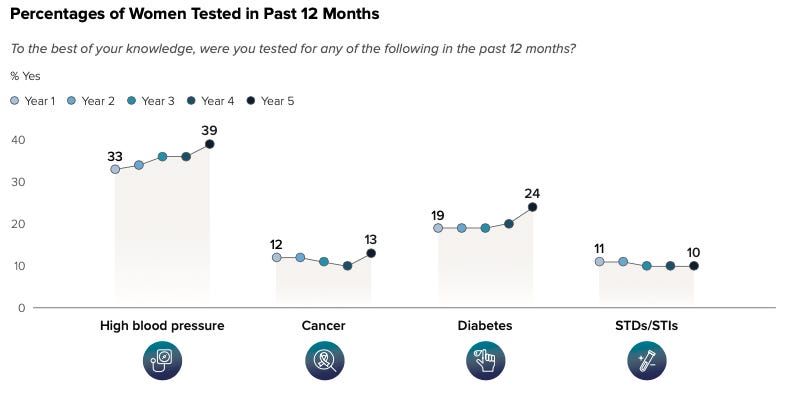
📌 GLOBAL: Women’s health stalls despite rise in screening, latest Hologic Index finds. There’s not a lack of innovation in women’s health, but it’s not yet scaling to the people who need it the most. Hologic’s latest global women’s health index has found that while more women globally are being tested for cancer, diabetes and high blood pressure than at any point in the past five years, overall progress remains flat. The index identified a global score of 54/100 - unchanged since 2020. The data, drawn from 2024, also captures a critical moment just before major reductions in global health funding began in 2025. The report also reinforces that women’s health outcomes are shaped by far more than healthcare - including safety, economic stability and access to basic needs such as food and housing. (Continue reading: FutureFemHealth)
📌 US: Autoimmune disease is limiting women in the workforce. Around 80% of autoimmune patients are women - and new survey data from WellTheory and the Autoimmune Association suggests the career impact is significant. 70% of working women with an autoimmune condition say it has limited their career potential, with 39% reducing hours, 28% moving to less demanding roles and 11% leaving the workforce entirely. The findings also highlight a heavy reliance on employer-based insurance, with two-thirds staying in jobs to keep coverage, while 61% report symptoms disrupting their ability to work on a regular basis. Despite this, most women do not fully disclose their condition at work, pointing to ongoing stigma. The data highlights how chronic illness is becoming an under-recognised driver of women’s workforce participation - with implications for employers, benefits design and retention. (Continue reading: Yahoo Finance)
📌 US: Early menopause linked to significantly higher lifetime heart disease risk. Women who experience menopause before age 40 face a roughly 40% higher risk of coronary heart disease, according to a new study in JAMA Cardiology. The research, based on data from more than 10,000 women followed over several decades, also highlights racial disparities: Black women are three times more likely than white women to experience premature menopause. While the biological link remains unclear, researchers say early menopause should be treated as a key risk signal in cardiovascular prevention, prompting earlier screening and intervention. The findings add to growing evidence that reproductive health history - including menopause timing - plays an important role in long-term heart disease risk. (Continue reading: Stat News)
📄 Policy watch: risks and opportunities

📌 UK: Menstruation costs £20,000+ over a lifetime, prompting calls for government action. New data from cycle tracking app Clue estimates that women and people who menstruate spend an average of £20,359 across their lifetime on period-related costs, including products, pain relief and associated expenses. More than a third (37%) say they struggle to afford period products, with 39% cutting back on essentials such as food or bills, and nearly 40% resorting to alternatives like tissues due to cost. The findings also point to wider economic and workplace impact, with 44% saying menstruation affects their ability to do their job and 41% reporting missed work. Campaigners are calling for free access to period products in England, with 82% of respondents supporting wider provision across schools, universities and workplaces. Scotland already became the first country in the world to make period products free in November 2020, placing a legal duty on local authorities to ensure access for anyone who needs them. (Continue reading: MSN)
📌 UK: House of Lords backs bid to decriminalise abortion. In England, Scotland and Wales, abortion is legal up to 24 weeks with the approval of two doctors. However, after 10 weeks the procedure must be carried out in an approved clinic or NHS hospital. Abortions after 24 weeks are allowed only if the woman’s life is in danger, if there is a severe fetal abnormality or if the woman is at risk of grave physical and mental injury. Labour MP Tonia Antoniazzi launched her bid to end police investigations into abortion under a 164-year-old Victorian law last year, with an amendment to the Crime and Policing Bill. More than 100 prosecutions have taken place in recent years. Peers have now backed the call for change. (Continue reading: BBC)
📌 UK / GLOBAL: First Lancet Psychiatry Commission on women’s mental health launched. King’s College London will co-lead the first-ever Lancet Psychiatry Commission focused on women’s mental health, bringing together international experts to examine gaps in research, care and policy. The initiative is expected to shape future priorities across areas including reproductive mental health, gender bias in diagnosis and access to care. While early-stage, it signals growing recognition of women’s mental health as a distinct and under-addressed global health issue. (Continue reading: King’s College London)
📆 Save the date
📌 Women’s Health Innovation and Leadership (WHIRL) Summer School, London, July 1-3. A three-day immersive programme bringing together early-career researchers, clinicians and innovators who want to tackle some of the most pressing challenges in women’s health.
👉 Apply here
📌 London Business School Healthcare Conference 2026, London, March 30-31. Two evenings of debate, practical insights and high-signal networking across healthtech, life sciences, pharma, payers/providers and investing. This year’s theme is ‘The Longevity Frontier’
👉 Book your ticket here.
📌 Annual Conference - Tufts University Center for Black Maternal Health and Reproductive Justice. Virtual, April 10-11. Exploring the future of women’s health through the lens of equity. This year’s program covers critical topics such as heart health and maternal outcomes, fibroids and fertility equity. Ticket include recording.
✅ Hiring now
📌 REMOTE/US: Brand Marketing Lead, Cofertility
📌 US: Head of women’s health portfolio, Bayer
📌 UK: Account Manager, UK and International, Mooncup
That’s all for this week! If you’ve missed any previous newsletter issues catch them all at futurefemhealth.com and do make sure to follow us on LinkedIn and you can connect with me directly.
Anna

Before you go: FutureFemHealth reaches 100,000+ women’s health innovators each month - founders, operators, clinicians and investors. Want to partner with us? Explore opportunities or request our media pack contact: anna@futurefemhealth.com
Always so insightful thank you