


Welcome to issue #133 FutureFemHealth, (w/c February 9 2026) — the global weekly briefing on women’s health innovation.
🌟 In this week’s briefing:
🩸 Menstrual blood diagnostics edge towards the mainstream
❤️ $55m Wellcome Leap program targets overlooked heart disease in women
🔥 Clair moves out of stealth with continuous hormone tracking wearable
✅ Calla Lily lands Merck as first industry partner
🩸Menstrual blood diagnostics in 2026: what’s changing - and what we’re tracking

Menstrual blood is slowly — and now publicly — being reframed from ‘waste’ to ‘a legitimate source of clinical insight’.
Last week, the BBC covered period blood testing as a potential alternative approach for HPV screening.
That specific research is early stage and won’t be right for everyone. But that’s not really the point. What matters in this story is that a national public broadcaster talked about menstrual blood as a serious contender for use within the NHS, rather than just as a fringe idea.
Menstrual blood has long been overlooked in medicine, largely due to stigma. But clinicians, researchers and founder have been championing it for years as a treasure trove of insights.
We now know that it contains rich biological information that could inform everything from HPV screening and endometriosis detection to fertility treatment planning and hormone health.
We also know that once a topic like menstrual blood diagnostics emerges from the shadows of silence, we tend to see more demand, funding and interest follow - as has been the case with menopause (which I wrote about last week).
In a FFHi Brief, I break down:
why menstrual blood diagnostics are entering the mainstream now
21 companies I’m currently tracking in the space
and the nine signals that are helping me assess whether this becomes a real, scalable healthcare category — from regulation and clinical validation to narrative shift, inclusivity, funding and follow-up care
One key takeaway: like so many areas of women’s health this market can only truly exist once the story changes and consumer demand takes over. That shift is underway, but there’s still a long way to go and individual companies can’t do it alone…particularly when you throw censorship into the mix too.
👉 Read the full deep dive here: Menstrual blood diagnostics in 2026
Have your say…
Last week’s poll asked: Will data privacy meaningfully influence which women’s health apps succeed? 62% of you said that yes, privacy-first is the moat in women’s health. 29% of you said privacy was important, but not decisive.
✅ Let’s partner in 2026?
Each month FutureFemHealth reaches 100,000+ women’s health innovators in 109+ countries across our newsletter, social media channels and website.
We are not a mass media channel, we are a high-trust, highly-targeted briefing read by the people who are building, funding and shaping women’s health.
In 2026 we have a limited number of partnerships for organisations who want to:
Lead the narrative on complex and/or emerging women’s health topics
Build credibility and trust with industry peers - founders, operators, clinicians and investors.
Engage leaders through thoughtful content that sparks connection, conversation and collaboration.
📩 2026 partnership slots are now open. To explore opportunities or request our media pack contact: anna@futurefemhealth.com
💰 Capital flows and funding signals

📌 GLOBAL: Wellcome Leap launches $55m program to tackle overlooked heart disease in women. Too many women leave heart checks with “normal” results and no answers — because their disease is in vessels doctors can’t see. Now VISIBLE, a new $55m programme from Wellcome Leap together with Pivotal and the British Heart Foundation is aiming to transform how coronary microvascular disease is diagnosed and treated. The ambition is to move women’s heart care from guesswork to precision and shift diagnosis rates from a shockingly low 1% up to 80% and beyond. (Continue reading: FutureFemHealth)
📌 INDIA: Wellcome awards £5.3million grant to Wysa for adolescent mental health study in India. India has the largest adolescent population globally at more than 253 million and young girls experience higher rates of anxiety and depression than boys. This study will identify barriers that limit access to mental health support for girls and inform adaptations to Wysa’s digital interventions. (Continue reading: Digital Health News)
🌟 Industry moves and strategic shifts

📌 US: Clair moves out of stealth with continuous hormone tracking wearable. Hormone insight has usually meant blood draws, urine strips or decoding your cycle tracking. Clair wants to change that. Its wrist-worn device is designed to continuously estimate estrogen, progesterone, LH and FSH patterns without needles, by analysing the signals the body already produces, like temperature, heart rate and sleep. In early testing across 127 cycles, the company reports 94% accuracy in identifying cycle phase. The potential for this spans fertility tracking, training optimisation and perimenopause support — giving users ongoing insight rather than one-off tests. With a beta app launching this month, hardware due in November, and funding underway, Clair is starting as a wellness device — with FDA-cleared hormone readings planned later. (Continue reading: FutureFemHealth)
📌 UK: Calla Lily secures Merck as first industry partner for intravaginal drug delivery platform. Calla Lily’s patented, tampon-shaped device is designed to support leak-resistant, more consistent drug delivery and a better experience for patients. Now in its first industry partnership, Calla Lily has entered a strategic collaboration with Merck to support the continued development of its novel platform. (Continue reading: FutureFemHealth)
📌 US: Onsite Women’s Health launches AI-enabled mammography programme to surface cardiovascular risk Millions attend mammogram appointments yet cardiovascular disease is the leading cause of death for women. Now a new program, Mammo with Heart, uses FDA-cleared artificial intelligence from CureMetrix to detect breast arterial calcifications (BAC) — a finding associated with cardiovascular disease — during standard 3D mammography exams. The two-for-one’ approach meets women where they are, improves early detection and expands the value of the traditional mammogram. While early launch is one clinic, Onsite provides services in more than 175 practices in 28 U.S states nationwide indicating a fast potential to scale. (Continue reading: FutureFemHealth)
📌 US / UK: From NHS entry to US acquisition: how Fetal Pillow scaled and exited as a women’s health device. It was 2006 when a second-stage C-section went tragically wrong — a moment that stayed with obstetrician Dr Rajiv Varma and led to the development of a medical device, Fetal Pillow. Over the next decade, Dr Varma was joined by his son and co-founder Nishant Varma, who supported the company’s launch into the NHS, and later led its scale across the US hospital system and its eventual acquisition by CooperSurgical. Nishant looks back on what it really takes to scale - and be bought - in women’s health. (Continue reading: FutureFemHealth - partner content)
📌 GLOBAL: Garmin smartwatch data integrated into women’s metabolic health platform Hello Inside. This new collaboration means women managing their metabolism can layer on sleep, stress, activity and cycle data directly onto continuous glucose data. The result is that users can see not just their wearables data, but also how those behaviours show up in glucose levels over time too - enabling longitudinal tracking and more actionable insights. It’s a shift that better accounts for women’s hormonal physiology in metabolic health. (Continue reading: FutureFemHealth)
📌 GLOBAL: Why women’s health data needs a different future. Incredible volumes of women’s health data now exists - in our apps and wearables, our healthcare systems, with researchers and more. But collaborating is full of friction - setting up a compliant data collaboration between an app and a research institution can take months of legal work, bespoke agreements and duplicated effort. Hanah Ecosystem is focused on addressing this bottleneck - making ethical collaboration possible in a faster and still secure way. (Continue reading: FutureFemHealth)
🎨 Creative call: tackling women’s health censorship
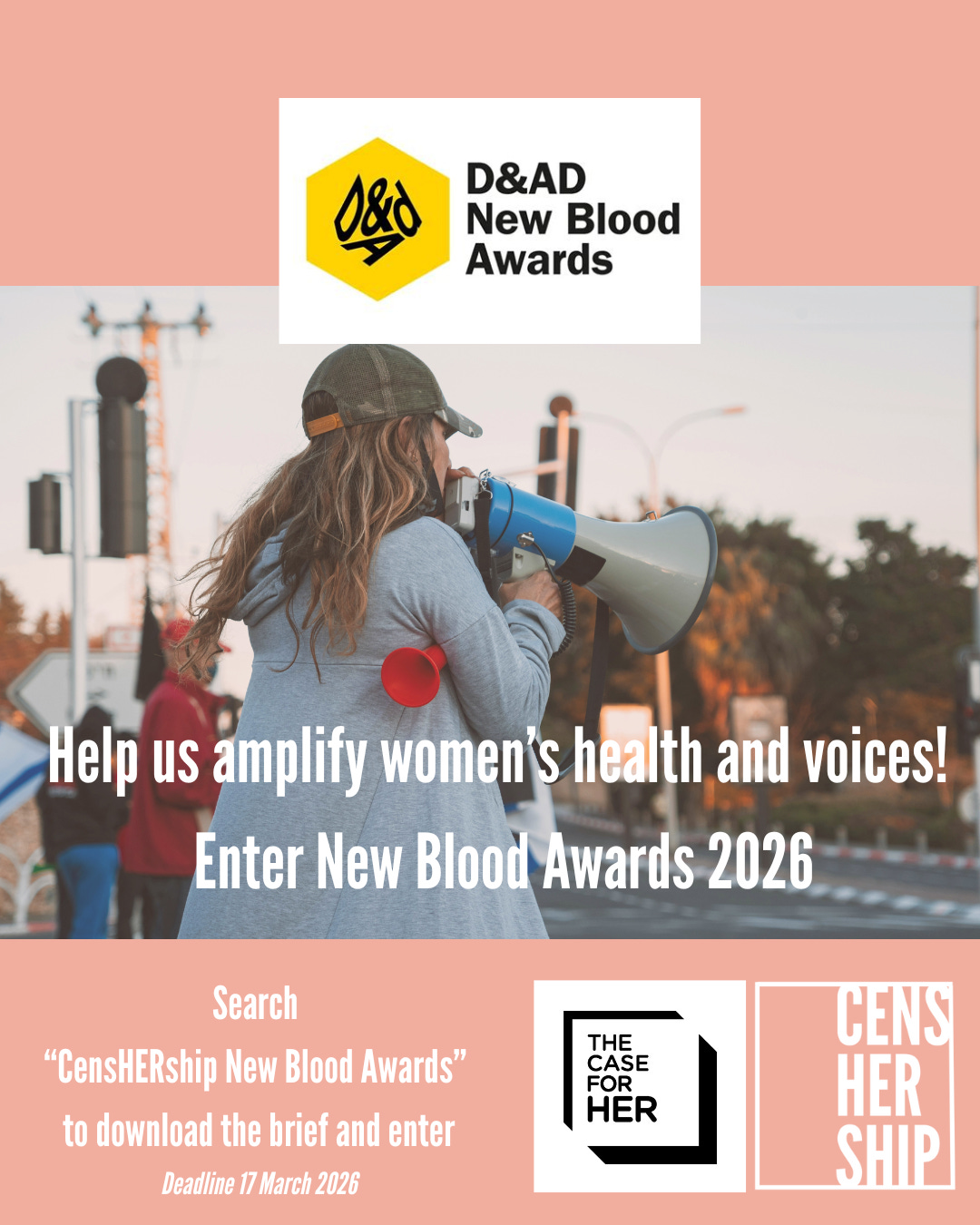
Do you know an emerging creative mind that could help tackle the issue of censorship of women’s health content?
The prestigious D&AD New Blood Awards invite the next generation of creative talent to use their ideas to change the world. And this year, CensHERship and The Case for Her have teamed up to create a brief all about tackling censorship.
Creatives will help to drive awareness of the hypocrisy of women’s health censorship, design a tool or idea to help CensHERship gather evidence and reveal the true scale of the problem.
Read the full brief here, or help spread the word about the awards by sharing our LinkedIn post. Closing date is 17 March 2026.
📄 Policy watch: risks and opportunities
📌 EUROPE: 170 organisations call on European Commission to respond positively to My Voice, My Choice abortion campaign. An estimated 20 million women in Europe lack access to appropriate abortion services, according to the EU-wide My Voice, My Choice activist movement. In the latest phase of a campaign to fund safe access across the EU, an open letter urges commitment to a concrete legislative proposal. (Continue reading: Reproductive Rights)
📌 UK: Almost 70% of NHS areas in England offer only one cycle of IVF, data shows. The NHS estimates that about one in seven couples may have difficulty achieving a pregnancy and the National Institute for Health and Care Excellence (Nice) recommends three full NHS-funded cycles for women under 40. Yet despite this recommendation being in place for more than 20 years — it’s never actually been implemented in England, leading to a ‘postcode lottery’ where entitlements vary depending on where you live. New Nice guidelines are due in the Spring. (Continue reading: The Guardian)
📆 Save the date
📌 LONDON: Health2Tech - Setting the foundation for a future exit: Success in the US market as a UK medical device startup in women’s health (with Nishant Varma, co-founder of Fetal Pillow), Tuesday 24 February, 5.30pm GMT.
🎟️ Register here.
📌 VIRTUAL: Beyond the noise - how Garmin Health and Hello Inside can turn body signals into metabolic resilience. Wednesday 25 February, 4.30pm CET.
🎟️ Register here.
📌 LONDON: The Women’s Domain: CensHERship and the Femtech Economy. Navigating the digital barriers in women’s health. Thursday 26 Feb, 6pm GMT. (I’ll be joining my CensHERship co-founder Clio Wood to speak at this one!)
🎟️ Register here.
📌 LONDON: Endometriosis: Lived experience, psychology of chronic disease, innovation and research, with Nexus Connected and Barclays Innovation Hub. Wednesday 4 March, 8.15am GMT.
🎟️ Register here.
✅ Hiring now
📌 UK: Various roles, Hesta Health
📌 U.S: Chief of Staff, Foreground Capital
📌 PORTUGAL: Global Digital Operations Manager, Ferring Pharmaceuticals
That’s all for this week! If you’ve missed any previous newsletter issues catch them all at futurefemhealth.com and do make sure to follow us on LinkedIn and you can connect with me directly.
Anna

Before you go: Want to partner with us? To explore opportunities or request our media pack contact: anna@futurefemhealth.com
Wow, had no idea that menstrual blood could be used for diagnostics. Something I'll keep an eye on in the future!
Hi Anna,
I would like to personally invite you to follow Gals Bio (http://www.galsbio.com) and learn more about our device, Tulipon. Our technology enables Sensopad to collect menstrual fluid for the diagnosis of endometriosis.
In addition, we are developing a new branch in women’s health called Fem-Wearables, where our device will empower menstruators to monitor their health through biomarkers found in menstrual fluid, including potential cancer indicators and other conditions.